

Toronto’s Skyscraper Race That No One Is Talking About
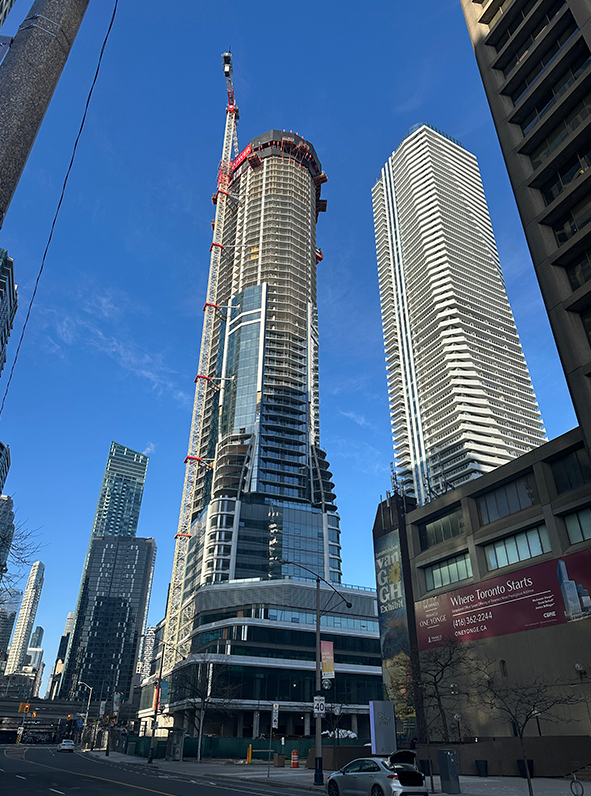
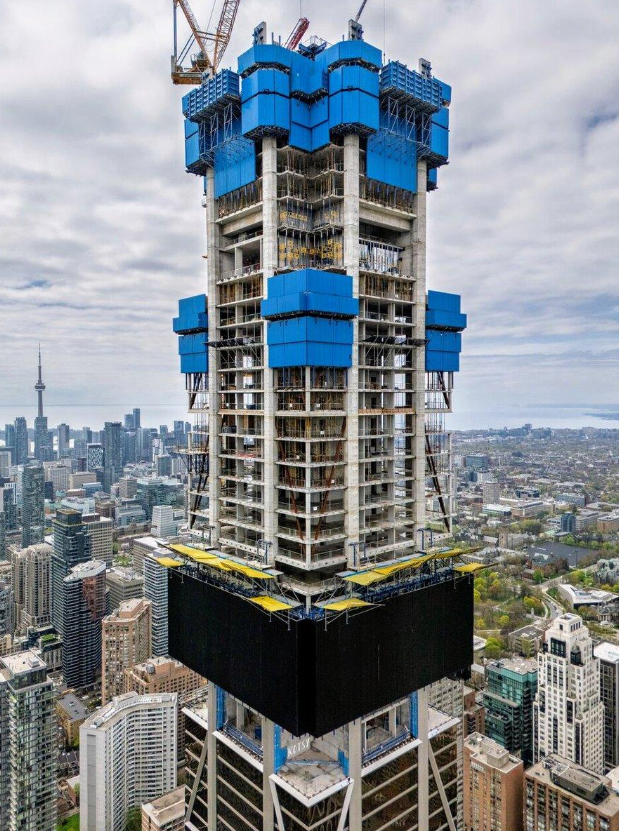
A construction view of SkyTower at Pinnacle One Yonge, the 351.4-metre, 106-storey giant that has dramatically raised the ceiling for Toronto skyscrapers. This is an ideal lead image for the section discussing Canada's new generation of supertalls.
For decades, Toronto’s skyline had a clear hierarchy.
The CN Tower dominated everything. Below it, First Canadian Place stood as the undisputed king of the city’s actual skyscrapers. Completed in 1975 at roughly 298 metres, the white-clad office tower held the title of Canada’s tallest building for half a century.
Then, almost quietly, Toronto entered a completely different era.
Today, multiple towers around the city are pushing toward — or beyond — the 300-metre mark. One has already climbed past 350 metres. Others are rising along Yonge Street and through the downtown core. And unlike the skyscraper races associated with New York, Dubai, or cities in China, Toronto’s vertical transformation has received relatively little international attention.
Yet the numbers tell an extraordinary story.
Toronto is no longer simply experiencing another condominium boom.
It is experiencing a genuine skyscraper race.
And within only a few years, the upper end of Toronto’s skyline is being rewritten almost completely.
The 50-Year Record That Suddenly Fell
To understand what is happening, you have to start with First Canadian Place.
The 298.1-metre office tower was completed in 1975 and became Canada's tallest building. For generations, virtually every major tower constructed in Toronto stopped somewhere below it.
Buildings such as Scotia Plaza and what is now the St. Regis Toronto dramatically expanded the skyline, but neither surpassed First Canadian Place.
Even Toronto’s enormous condominium boom of the 2000s and 2010s failed to break the record.
That created an unusual situation.
Toronto was building an extraordinary number of high-rises, but the very top of the skyline remained practically frozen.
Then the 2020s arrived.
Suddenly, developers were no longer proposing buildings in the 200-to-250-metre range.
They were aiming for 300 metres.
And then 350.
The Council on Vertical Urbanism’s Skyscraper Center currently lists Toronto’s tallest new generation of towers as SkyTower at 351.4 metres, One Bloor West at 308.6 metres, and Concord Sky at 300.2 metres.
In other words, a height record that survived approximately half a century has suddenly been attacked by several projects at almost the same time.
Source: Council on Vertical Urbanism – The Skyscraper Center
https://www.skyscrapercenter.com/explore-data?city_id=723
SkyTower Just Changed the Entire Competition
The most important building in Toronto’s current skyscraper race is rising at the foot of Yonge Street.
SkyTower at Pinnacle One Yonge reaches approximately 351.4 metres, or 1,153 feet.
It contains 106 floors.
That makes it dramatically taller than First Canadian Place and pushes Toronto firmly into the territory of the modern supertall skyscraper.
A “supertall” is generally defined as a building at least 300 metres tall. Toronto spent decades without a completed building crossing that threshold.
Now SkyTower does not simply cross it.
It clears it by more than 50 metres.
The tower structurally topped out in 2026, according to the Council on Vertical Urbanism, with completion expected in 2026.
Its scale is difficult to appreciate from statistics alone.
At 351.4 metres, SkyTower is approximately 53 metres taller than First Canadian Place. It also contains more than 100 storeys, putting Toronto into a relatively exclusive club of cities capable of supporting extremely tall residential construction.
The project is part of the larger Pinnacle One Yonge development, which includes residential, hotel, and office uses. According to the Skyscraper Center, the complex is planned around roughly 2,470 apartments and 226 hotel rooms.
That is important because SkyTower represents something bigger than an architectural trophy.
This isn't a corporation constructing a monumental headquarters.
It is vertical urbanization.
Thousands of people are being concentrated into developments occupying pieces of downtown land that would have seemed impossibly dense only a generation ago.
Source: Council on Vertical Urbanism – SkyTower at Pinnacle One Yonge
https://www.skyscrapercenter.com/building/skytower/15295
Source: Council on Vertical Urbanism – Pinnacle One Yonge Complex
https://www.skyscrapercenter.com/complex/921
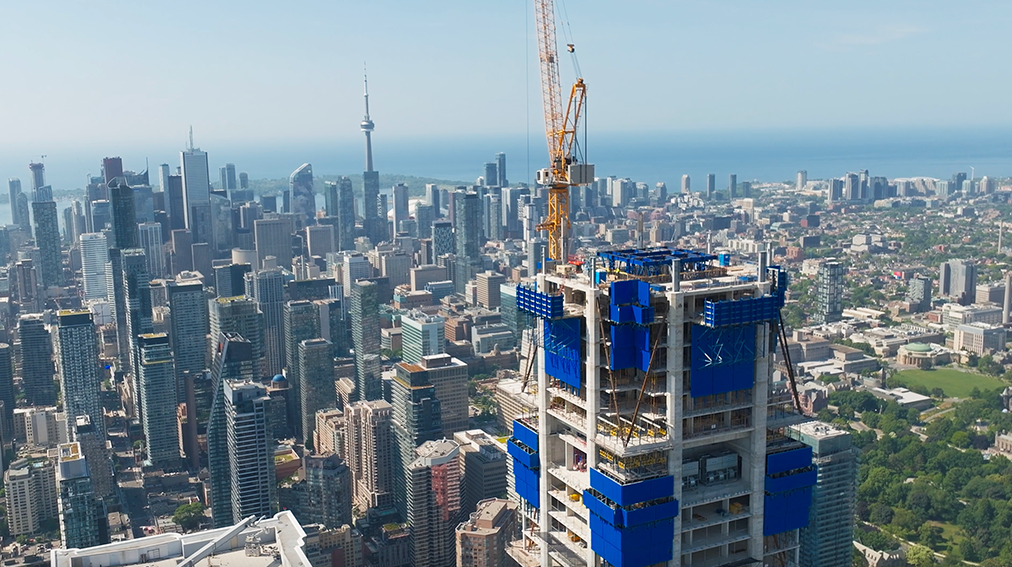
One Bloor West rises high above Toronto with cranes and construction equipment surrounding its upper floors. The image works particularly well for illustrating how close Toronto came to having a different skyscraper take the Canadian height crown.
One Bloor West Almost Won the Race
A few kilometres north, another extraordinary tower has been rising at one of Toronto's most recognizable intersections.
Today it is called One Bloor West.
Many Torontonians, however, still know it by its original name: The One.
Designed by Foster + Partners with Core Architects, the tower has experienced one of the most complicated development stories in recent Toronto history. Despite that history, the project has reached a height of approximately 308.6 metres.
That alone would have been historic.
At that height, One Bloor West surpasses First Canadian Place and crosses the internationally recognized 300-metre supertall threshold.
For a brief moment, the building represented what appeared likely to become Canada's new skyscraper champion.
Then SkyTower kept climbing.
The result created something Toronto had essentially never experienced before: two buildings competing for a national height record within the same construction cycle.
Instead of one developer finally breaking the First Canadian Place barrier and holding the crown for decades, Toronto immediately produced another project significantly taller.
One Bloor West is expected to contain approximately 85 floors and combine residential and hotel functions.
Its location also makes its height particularly significant.
Rather than being buried among the office towers of the Financial District, One Bloor West sits at Yonge and Bloor, extending Toronto's extreme vertical development northward.
The skyline is no longer concentrated exclusively around Bay Street and King Street.
Toronto's skyscraper geography is stretching along Yonge Street.
Source: Council on Vertical Urbanism – Toronto Building Database
https://www.skyscrapercenter.com/explore-data?city_id=723
Source: UrbanToronto – Transit Progress and Tall Towers Made Headlines in March 2026
https://urbantoronto.ca/news/2026/04/transit-progress-and-tall-towers-made-headlines-march-2026.60695
Then There Is Concord Sky
Continue south along Yonge Street and another contender appears.
Concord Sky is currently under construction at 385 Yonge Street.
Designed by Kohn Pedersen Fox with architectsAlliance, the tower is planned to reach approximately 300.2 metres.
That number might seem strangely precise, but it matters.
The 300-metre mark is the internationally recognized threshold separating ordinary tall skyscrapers from the “supertall” category.
Concord Sky barely crosses it.
But crossing it at all represents a remarkable change for Toronto.
The tower is expected to reach approximately 85 floors and is currently projected for completion in 2027.
If Concord Sky had been constructed only a decade earlier, it could have become one of the most famous skyscrapers in Canadian history.
Instead, it is being built at the same time as multiple comparable giants.
That may be the best evidence of just how rapidly Toronto has changed.
A 300-metre skyscraper is becoming almost normal.
Source: Council on Vertical Urbanism – Concord Sky
https://www.skyscrapercenter.com/building/concord-sky/35295
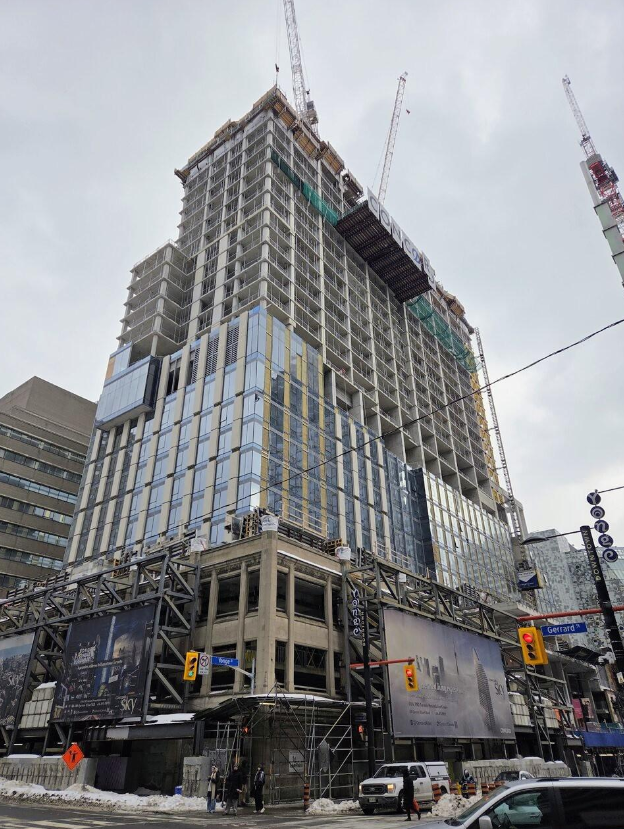
A street-level construction photograph showing Concord Sky climbing above Yonge Street. The cranes, exposed structure, glass curtain wall, traffic, and surrounding buildings help communicate just how intensely Toronto's downtown core is being redeveloped.
Toronto Is Building an Entire Generation of Giants
The race does not stop with those three towers.
Another major project reshaping the skyline is Forma.
The development is especially notable because of the architect behind it: Frank Gehry, who was born in Toronto.
Forma is planned as a pair of towers in the King Street West area. The taller eastern tower has been reported at roughly 300 metres in some project materials and databases, although height figures have evolved through the project's design and approval history.
UrbanToronto listed the project in March 2026 at approximately 308 metres and 84 storeys.
The Council on Vertical Urbanism database currently lists Forma East Tower at 266.5 metres, illustrating an important reality of skyscraper development: proposed heights, approved designs, construction plans, and final certified heights can change.
What does not change is the broader trend.
Toronto has a pipeline filled with buildings that would have been skyline-defining landmarks individually.
Now they are arriving together.
Source: UrbanToronto – Transit Progress and Tall Towers Made Headlines in March 2026
https://urbantoronto.ca/news/2026/04/transit-progress-and-tall-towers-made-headlines-march-2026.60695
Source: Council on Vertical Urbanism – Toronto Building Database
https://www.skyscrapercenter.com/explore-data?city_id=723
Why Is Toronto Suddenly Building So High?
The obvious question is why.
Why did a city that went approximately 50 years without surpassing First Canadian Place suddenly start building several towers around or above 300 metres?
There isn't one explanation.
There are several forces converging simultaneously.
Toronto has experienced enormous population growth and sustained demand for housing. Land in desirable, transit-accessible parts of the city is extraordinarily valuable. That makes density increasingly important to the economics of major downtown developments.
Developers are therefore attempting to extract more usable floor area from limited parcels.
The result is vertical development.
But Toronto's transportation geography matters too.
Many of the city's largest projects are concentrated around major subway stations, streetcar corridors, GO Transit connections, and the PATH network.
One Bloor West sits directly above one of Canada's busiest subway intersections.
Concord Sky rises beside College subway station.
SkyTower stands near Union Station, the waterfront, GO Transit, the subway system, and Toronto's expanding PATH network.
These aren't random locations.
They are transportation nodes.
Toronto is effectively building enormous vertical neighbourhoods around infrastructure capable of moving thousands of people.
The City of Toronto has also been updating zoning around Major Transit Station Areas, part of a broader attempt to accommodate growth near high-capacity public transportation.
Source: City of Toronto – Zoning for Major Transit Station Areas
https://www.toronto.ca/city-government/planning-development/planning-studies-initiatives/zoning-for-major-transit-station-areas/
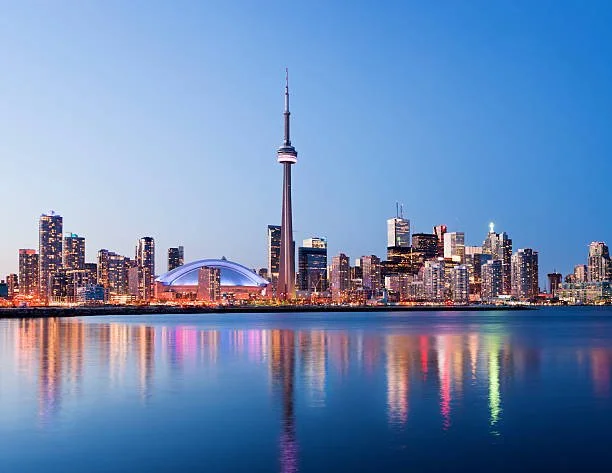
A wide waterfront view establishing the scale and density of Toronto's existing skyline. This works as a visual reset between individual tower sections and helps readers understand the larger urban environment into which the new generation of supertalls is being inserted.
This Isn't Really a Race Between Buildings
The most interesting part of Toronto's skyscraper boom is that the buildings themselves may not actually be the competitors.
The real competition is between developers, neighbourhoods, transit corridors, and pieces of land.
A parcel sitting beside a subway station in downtown Toronto can potentially support thousands of residents.
That makes height economically valuable.
And once one developer demonstrates that a 300-metre residential building is technically, financially, and politically possible, other developers have an incentive to pursue similar density.
That creates a feedback loop.
A 70-storey building makes an 80-storey building seem less extraordinary.
An 80-storey tower makes 90 storeys imaginable.
Then someone builds 106.
The psychological ceiling changes along with the physical skyline.
Toronto Is Becoming a North American Skyscraper Capital
Toronto's skyscraper boom also looks very different when viewed from outside Canada.
According to the Council on Vertical Urbanism, Toronto already ranks among North America's leading cities for buildings exceeding 150 metres.
Historically, New York and Chicago dominated discussions of North American skyscrapers.
Toronto rarely entered the international conversation despite having an enormous high-rise inventory.
That perception is becoming increasingly outdated.
The city is developing a skyline where 200-metre residential towers are increasingly common and 300-metre towers are no longer theoretical.
That puts Toronto in a very different architectural category.
Source: Council on Vertical Urbanism – Toronto
https://www.skyscrapercenter.com/city/toronto
A dramatic aerial-style construction view showing One Bloor West in the foreground and the CN Tower in the distance. This is one of the strongest visual representations of the article's central idea: a new generation of enormous towers is beginning to compete with Toronto's established skyline landmarks.
But There Is Another Side to the Boom
A skyline filled with cranes does not automatically mean a city has solved its housing problems.
Toronto's development pipeline remains enormous, but moving a project from proposal to approval to construction to actual occupancy can take years.
The City of Toronto tracks thousands of projects at different stages of the development process, including applications, approvals, permits, construction, and completed buildings.
In 2026, Toronto reported progress toward provincial housing targets, but the city's own tracking showed a substantial difference between units approved and units actually started or completed.
That distinction matters.
Toronto can approve enormous towers.
The more difficult challenge is making projects financially viable, constructing them, connecting them to infrastructure, and delivering housing people can actually afford.
Source: City of Toronto – Planning and Development
https://www.toronto.ca/city-government/data-research-maps/research-reports/planning-development/
The Skyline of 2030 Will Look Completely Different
Stand somewhere along Toronto's waterfront today and look north.
The familiar skyline is still visible.
The CN Tower remains the dominant structure. The Financial District remains recognizable. First Canadian Place still looks enormous.
But its role has changed.
For half a century, First Canadian Place represented Toronto's architectural ceiling.
Now it represents the beginning of a new category.
SkyTower has climbed to 351.4 metres.
One Bloor West has reached roughly 308.6 metres.
Concord Sky is targeting approximately 300.2 metres.
Other extremely tall projects are reshaping neighbourhoods throughout downtown.
The remarkable thing isn't that Toronto finally built something taller than First Canadian Place.
It's that several developers decided to challenge the record almost simultaneously.
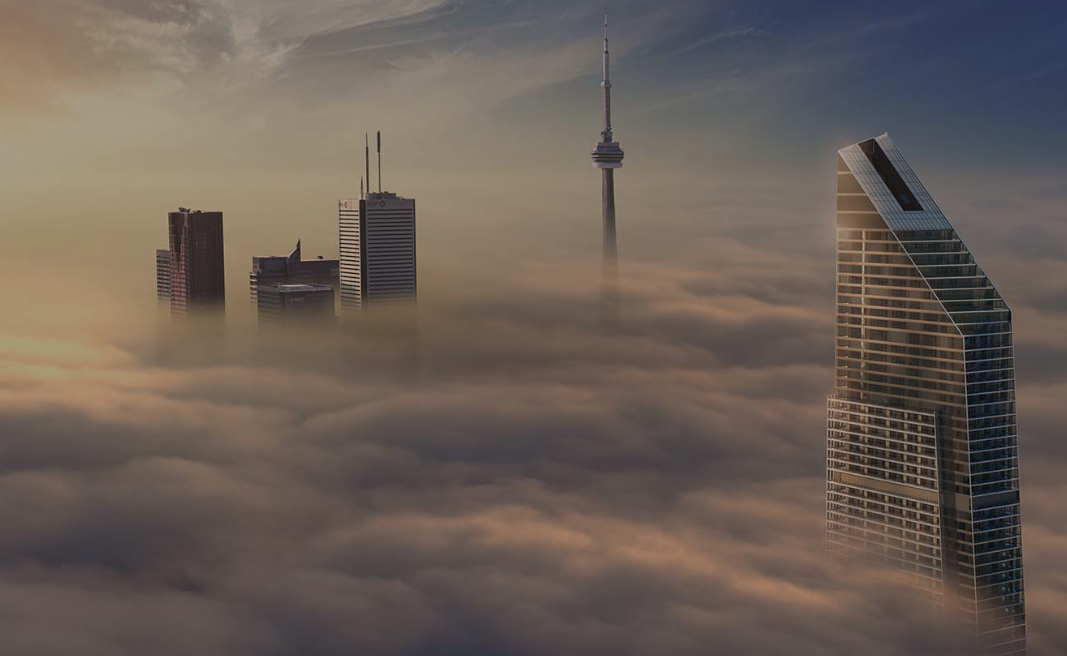
An architectural visualization showing the intended appearance of Concord Sky and its distinctive glass-and-steel form. Using a rendering alongside construction photography lets readers compare Toronto's unfinished skyline with what developers intend the city to look like when the current building cycle is complete. Concord describes the project as a major new downtown landmark designed by KPF.
The Skyscraper Race No One Is Talking About
There is no official starting gun.
There are no banners hanging over Yonge Street announcing the competition.
And Toronto's developers probably wouldn't describe themselves as participating in a skyscraper race.
But look at the skyline.
The evidence is difficult to ignore.
A record that survived for approximately 50 years has fallen.
The 300-metre barrier has been broken.
A 106-storey residential tower now rises above downtown.
And several other projects are clustered just beneath it.
Toronto spent decades growing outward and upward at the same time. Now scarcity of land, transit-oriented development, housing demand, and enormous real-estate values are pushing parts of the city toward a much more vertical future.
The CN Tower will almost certainly remain Toronto's defining landmark for years to come.
But underneath it, something historic is happening.
Toronto's skyscrapers are finally catching up.
And the race for the next generation of the Canadian skyline has already begun.
Sources
Council on Vertical Urbanism – SkyTower at Pinnacle One Yonge
https://www.skyscrapercenter.com/building/skytower/15295
Council on Vertical Urbanism – Pinnacle One Yonge Complex
https://www.skyscrapercenter.com/complex/921
Council on Vertical Urbanism – Concord Sky
https://www.skyscrapercenter.com/building/concord-sky/35295
Council on Vertical Urbanism – Toronto Building Database
https://www.skyscrapercenter.com/explore-data?city_id=723
Council on Vertical Urbanism – Toronto
https://www.skyscrapercenter.com/city/toronto
City of Toronto – Planning and Development
https://www.toronto.ca/city-government/data-research-maps/research-reports/planning-development/
City of Toronto – Zoning for Major Transit Station Areas
https://www.toronto.ca/city-government/planning-development/planning-studies-initiatives/zoning-for-major-transit-station-areas/
UrbanToronto – Transit Progress and Tall Towers Made Headlines in March 2026
https://urbantoronto.ca/news/2026/04/transit-progress-and-tall-towers-made-headlines-march-2026.60695
