

Surrey Langley SkyTrain Extension: The $6 Billion Transit Project Reshaping Metro Vancouver
By BuildBrief News Desk
For decades, Metro Vancouver’s SkyTrain system has expanded alongside one of Canada’s fastest-growing urban regions. What began as a relatively compact rapid-transit network has evolved into a transportation backbone connecting Vancouver, Burnaby, New Westminster, Richmond, Coquitlam and Surrey.
Now that network is pushing farther east.
The Surrey Langley SkyTrain extension is a massive 16-kilometre expansion of the Expo Line from the existing King George Station in Surrey to Langley City Centre. Running primarily above Fraser Highway on an elevated concrete guideway, the project will introduce eight new stations and bring rapid transit into communities experiencing some of the most aggressive population growth in British Columbia.
The scale of the project is considerable.
The approved budget stands at approximately $5.996 billion, while passenger service is currently expected to begin in late 2029. The Government of British Columbia is contributing approximately $4.4 billion, with another $1.3 billion coming from the Government of Canada.
But the Surrey Langley SkyTrain is more than another expensive transportation project.
It represents a fundamental shift in the geography of Metro Vancouver.
For decades, much of the region's rapid-transit infrastructure has been concentrated north of the Fraser River. Surrey and Langley, meanwhile, have continued expanding with enormous residential developments, commercial districts and employment centres.
By 2050, Surrey, Langley City and the Township of Langley are projected to add roughly 420,000 residents and 147,000 jobs.
The transportation system serving those communities must grow with them.
Construction is now well underway, and the enormous concrete structures rising along Fraser Highway provide the clearest indication yet that SkyTrain is finally coming to Langley.
Source: Government of British Columbia – Surrey Langley SkyTrain Project Overview
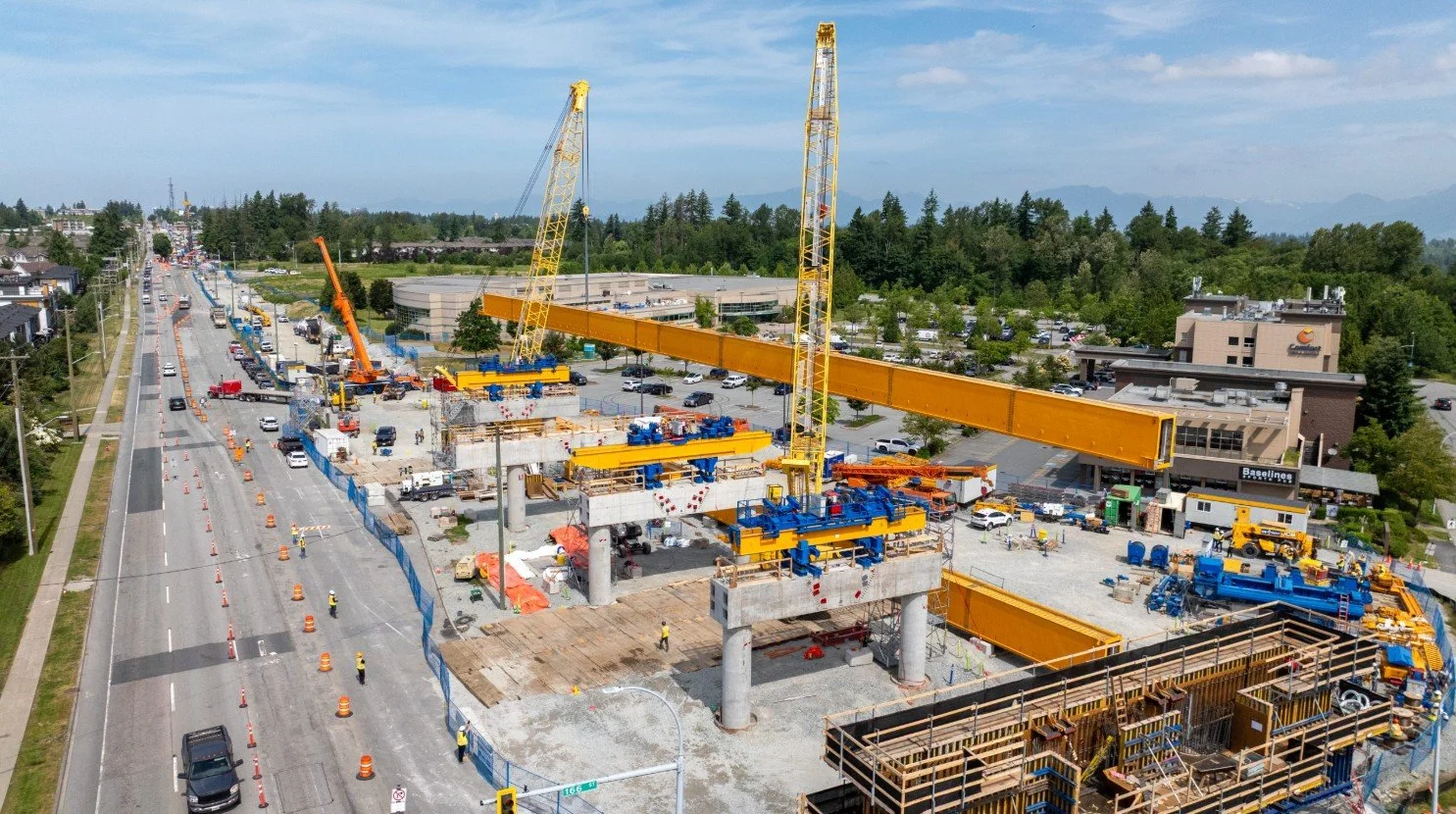
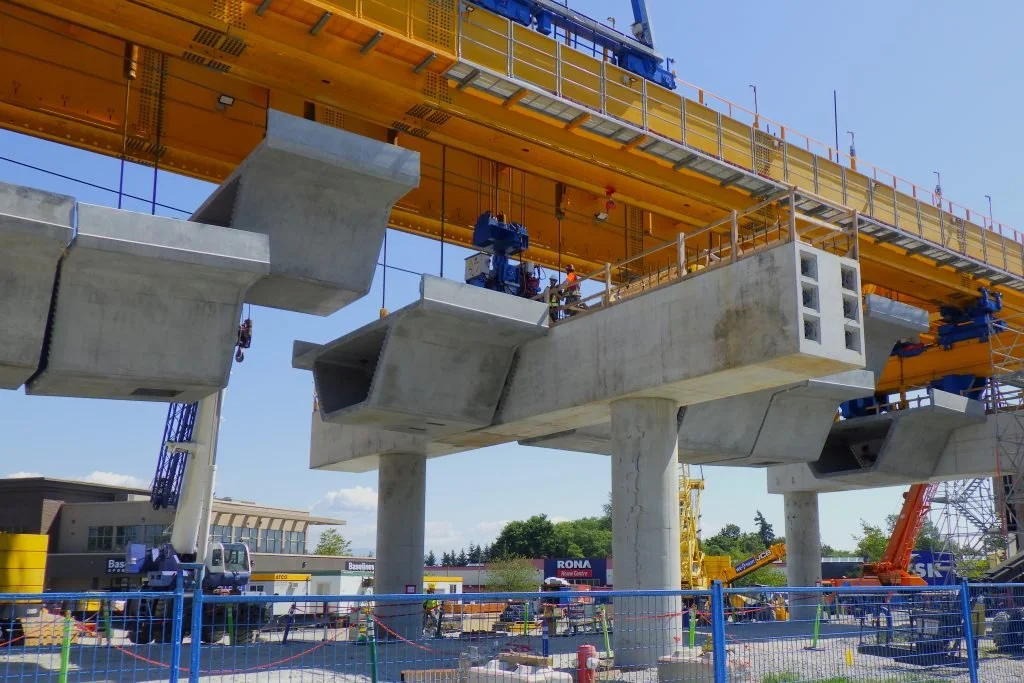
Use a wide construction photograph showing the concrete columns, elevated guideway and heavy equipment working along Fraser Highway. This is the strongest hero image because it immediately communicates the enormous physical scale of the $5.996 billion rapid-transit project. The official gallery includes June 2026 guideway construction photography.
A 16-Kilometre Extension of the Expo Line
The project begins where the Expo Line currently ends at King George Station in Surrey.
From there, trains will continue southeast primarily along Fraser Highway before eventually reaching Langley City Centre near 203 Street.
The extension will be almost entirely elevated.
Large concrete columns support precast guideway segments that form the railway above the roadway. It is a construction method already familiar throughout Metro Vancouver, where elevated guideways have helped define the visual identity of SkyTrain since the original Expo Line opened in the 1980s.
Eight new stations are being constructed along the route:
Green Timbers, 152 Street, Fleetwood, Bakerview–166 Street, Hillcrest–184 Street, Clayton, Willowbrook and Langley City Centre.
Three new transit exchanges are also planned at Bakerview–166 Street, Willowbrook and Langley City Centre, allowing passengers from surrounding communities to transfer between buses and SkyTrain.
The railway itself represents only part of the work.
Crews must construct electrical infrastructure, automated train-control systems, communications equipment, trackwork, utilities, roads, pedestrian connections and cycling infrastructure alongside the elevated guideway.
Once completed, Fraser Highway will effectively become one of Metro Vancouver's major rapid-transit corridors.
Source: Surrey Langley SkyTrain – Official Project Website
Source: City of Surrey – Surrey Langley SkyTrain
Why Surrey and Langley Need Rapid Transit
The argument for extending SkyTrain into Langley is largely an argument about population growth.
The communities south of the Fraser River are changing rapidly.
Surrey has developed into one of British Columbia's largest cities, while the Township of Langley and Langley City continue experiencing substantial residential and commercial development.
According to TransLink, Surrey, Langley City and the Township of Langley are expected to welcome approximately 420,000 additional residents and 147,000 additional jobs by 2050.
That creates an enormous transportation challenge.
Much of Surrey and Langley was historically developed around automobiles. Fraser Highway, Highway 1 and other arterial roads carry commuters between residential communities, employment centres and the wider Metro Vancouver region.
But there are physical limits to how many additional vehicles existing roads can absorb.
Rapid transit provides another option.
Instead of moving thousands of individual cars through the Fraser Highway corridor, SkyTrain can move large numbers of passengers using automated trains operating completely separated from road traffic.
That separation matters.
A train does not become trapped behind a traffic collision or morning congestion. Its travel time remains comparatively predictable even as surrounding roads become busier.
For a region expected to absorb hundreds of thousands of additional residents, that reliability could become increasingly valuable.
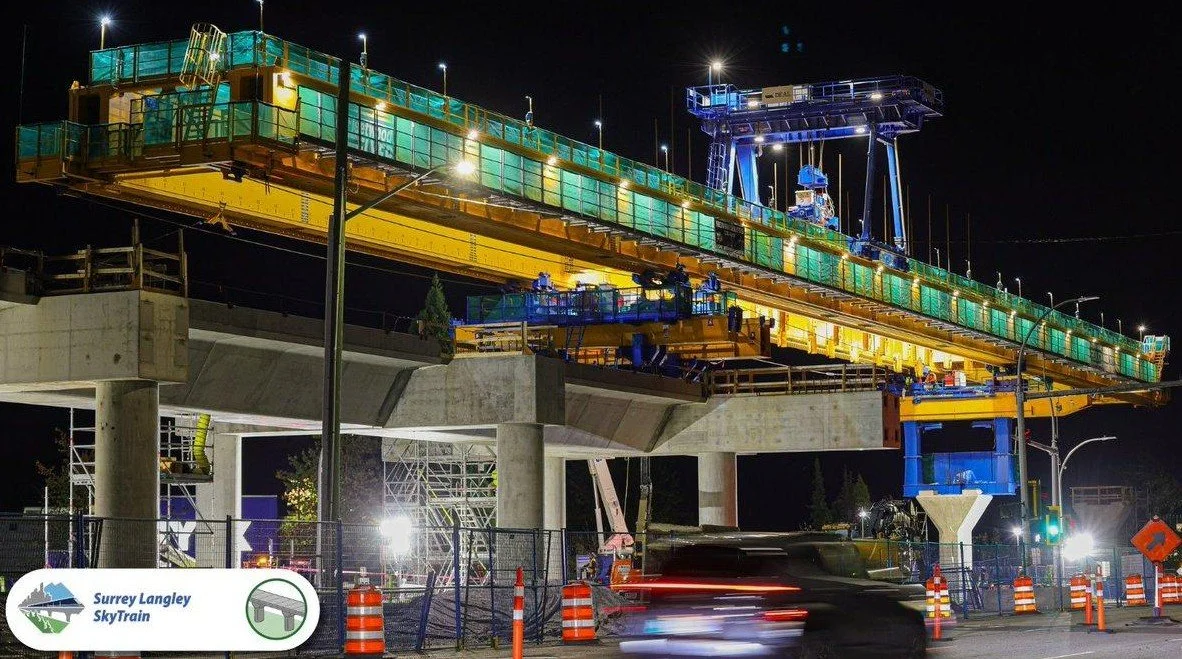
A dramatic photograph of one of the project's enormous launching gantries lifting precast concrete segments into position. This is an excellent engineering-focused image to place near the section discussing construction. The project's April 2026 status report specifically documents launching gantries constructing the elevated guideway. SkyTrain Surrey-Langley
From Light Rail to SkyTrain
The path toward the Surrey Langley SkyTrain was far from straightforward.
Metro Vancouver spent years debating what form rapid transit south of the Fraser should take.
One of the most prominent earlier proposals involved constructing a street-level light-rail system connecting Surrey City Centre with Newton and Guildford.
The project became politically controversial.
Supporters argued that light rail could create a broader local transit network and stimulate development along multiple corridors.
Critics argued that a street-running railway interacting with intersections and traffic would provide a slower and less effective service than grade-separated SkyTrain.
The political environment changed dramatically following Surrey's 2018 municipal election.
Plans for the light-rail network were effectively abandoned, and regional attention shifted toward extending the existing Expo Line along Fraser Highway toward Langley.
The decision had one enormous advantage.
Metro Vancouver already had decades of experience operating SkyTrain.
Rather than introducing another rail technology requiring separate vehicles, maintenance infrastructure and operating systems, the Fraser Highway project could become an extension of an established network.
Passengers boarding in Langley would eventually be able to continue west toward Surrey, New Westminster, Burnaby and Vancouver without transferring to another rail system.
The project that emerged from that debate became the Surrey Langley SkyTrain.
Source: TransLink – Surrey Langley SkyTrain Business Case
Why the Project Costs Nearly $6 Billion
The Surrey Langley SkyTrain currently carries an approved budget of approximately $5.996 billion.
That number is considerably larger than simply the cost of pouring concrete columns and installing railway tracks.
A modern automated railway requires an enormous collection of interconnected infrastructure.
Utilities must be relocated.
Foundations must be installed.
Roads must be reconstructed.
Stations require elevators, escalators, electrical systems, communications equipment and emergency infrastructure.
The elevated railway needs power distribution, trackwork, signalling and automated train-control technology.
Pedestrian and cycling connections must also be integrated around the stations.
The project has therefore been divided into several major construction packages.
The guideway contract covers construction of the elevated guideway along with associated roadworks, utilities and active-transportation infrastructure.
Another major contract covers construction of the eight stations.
A third package addresses systems and trackwork, including rails, power infrastructure, communications equipment and automated train controls.
This approach allows different teams to construct major components simultaneously rather than waiting for one contractor to complete the entire railway sequentially.
The provincial government has also explained that the project has been affected by the same economic pressures confronting major infrastructure programs around the world.
Inflation, rising commodity prices, supply-chain pressure and labour-market challenges contributed to higher contractor proposals and ultimately increased the estimated project cost.
Source: Government of British Columbia – Surrey Langley SkyTrain Project Update
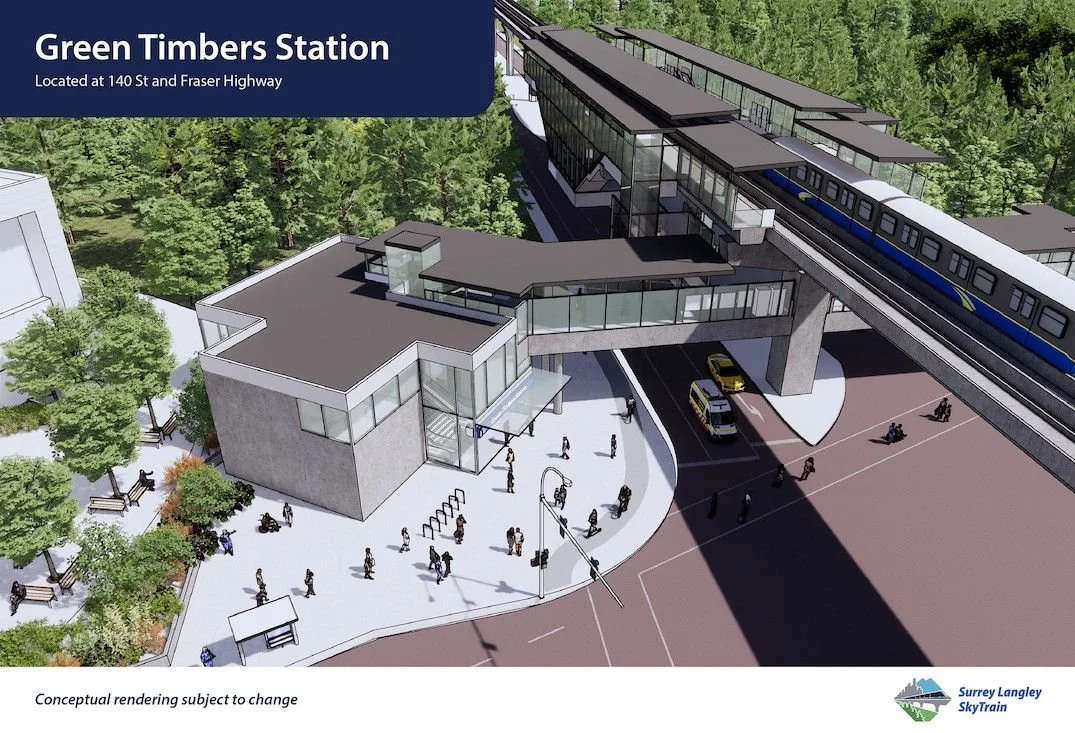
Use the official May 2026 aerial photograph of Green Timbers Station under construction. The elevated perspective helps readers understand how much infrastructure goes into an individual station and how the new railway is being integrated into the existing Fraser Highway corridor. SkyTrain Surrey-Langley
Construction Is Now Transforming Fraser Highway
By 2026, the Surrey Langley SkyTrain has moved decisively beyond planning.
Major construction is underway throughout the corridor.
The transformation is particularly visible along Fraser Highway, where concrete columns and elevated guideway sections are beginning to create the physical outline of the future railway.
By May 2026, construction had started at all eight stations.
More than 30% of the elevated guideway had already been installed, representing approximately five kilometres of the 16-kilometre route.
Four specialized launching gantries were operating along the alignment, lifting precast concrete guideway segments into position.
Meanwhile, approximately half of the required guideway segments had already been cast at the project's precast concrete facility in South Surrey.
Another major piece of infrastructure is hidden underground.
A roughly 16-kilometre underground duct bank will carry electrical infrastructure needed to power the railway. By May 2026, more than 75% of that system — approximately 12 kilometres — had been completed.
Track installation also began in late April 2026.
That represents an important transition.
A transportation project can spend years appearing to be little more than utility relocation, excavation and concrete construction. Installing rail makes the ultimate purpose of the structure considerably more obvious.
Fraser Highway is becoming a railway corridor.
Source: Government of Canada – New SkyTrain Stations Taking Shape for Transit Riders South of the Fraser
Source: Government of British Columbia – Surrey Langley SkyTrain Construction Updates
Building an Elevated Railway Through an Existing City
Constructing 16 kilometres of railway through an established urban corridor presents an enormous logistical challenge.
Fraser Highway cannot simply be closed for several years.
Businesses must remain accessible.
Residents must reach their homes.
Emergency vehicles need access.
Thousands of commuters still depend on the corridor every day.
Construction therefore has to occur while the surrounding transportation system continues operating.
As of summer 2026, single-lane traffic conditions were in effect along much of the Fraser Highway corridor, while some areas were experiencing additional lane closures and pedestrian or cycling detours.
Work includes foundations, columns, guideway installation, utility construction and station development.
In Langley, pile driving for guideway foundations has also created periods of increased noise and vibration.
The disruption is significant, but it illustrates one of the central difficulties of modern infrastructure construction.
Governments are attempting to install infrastructure needed for the next several decades inside communities that cannot simply stop functioning while that infrastructure is built.
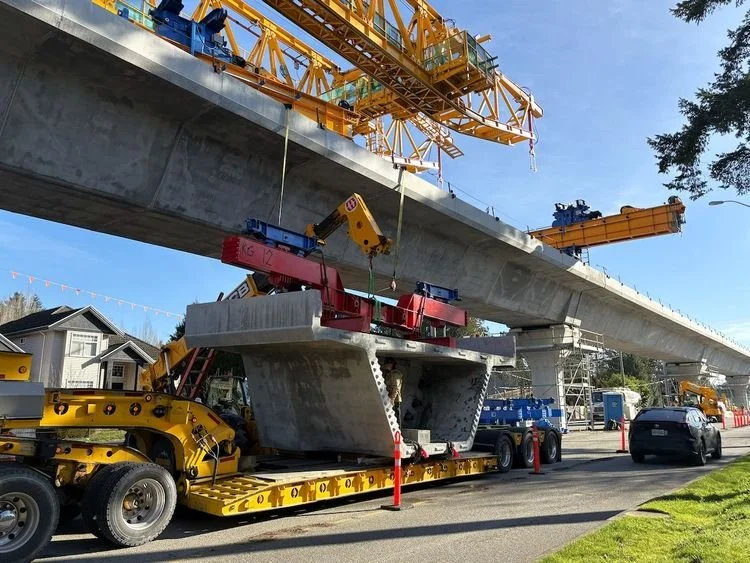
An image of the elevated railway taking shape through Fleetwood gives the article important neighborhood context. Rather than showing isolated construction equipment, this photograph demonstrates how the massive concrete structure interacts with existing streets, homes and businesses. The official gallery identifies a March 2026 image specifically showing guideway construction through Fleetwood. SkyTrain Surrey-Langley
Why the Opening Date Moved to 2029
Earlier versions of the project envisioned passenger service beginning in late 2028.
That target has changed.
The current anticipated opening date is late 2029.
The province has attributed the revised schedule and increased project cost partly to changes in construction-market conditions since the original business case was approved in 2022.
Inflation increased the cost of materials and labour.
Commodity prices rose.
Supply chains remained under pressure.
Competition for skilled construction workers intensified as major infrastructure programs moved forward throughout Canada.
Those forces matter considerably on a multibillion-dollar railway requiring enormous quantities of concrete, steel, electrical equipment and specialized labour.
Before passengers can board, the project must also complete far more than the visible guideway.
Stations must be finished.
Track must be installed.
Electrical infrastructure must be energized.
Communications and automated train-control systems must be integrated with the existing Expo Line.
Then the entire extension must undergo extensive testing.
The current target remains late 2029.
Source: Government of British Columbia – Surrey Langley SkyTrain Cost and Schedule Update
Langley to King George in About 22 Minutes
For passengers, one number may ultimately matter more than the project's construction statistics.
Twenty-two minutes.
That is the expected travel time between Langley City Centre and King George Station once the extension opens.
According to the provincial government, the journey is expected to be more than 25 minutes faster than the comparable existing bus trip.
But speed is only part of the benefit.
Reliability may prove equally important.
Because SkyTrain operates on dedicated infrastructure, trains are largely insulated from road congestion.
A trip that takes 22 minutes under normal conditions should not suddenly double because Fraser Highway becomes congested.
That predictability can fundamentally change commuting decisions.
Langley residents will also gain direct access to the broader SkyTrain network.
The extension will integrate with the existing Expo Line, allowing passengers to continue through Surrey toward New Westminster, Burnaby and Vancouver.
Through transfers elsewhere in the system, passengers can connect with the Millennium and Canada lines.
When the Surrey Langley extension opens, Metro Vancouver's interconnected rapid-transit network will exceed 100 kilometres.
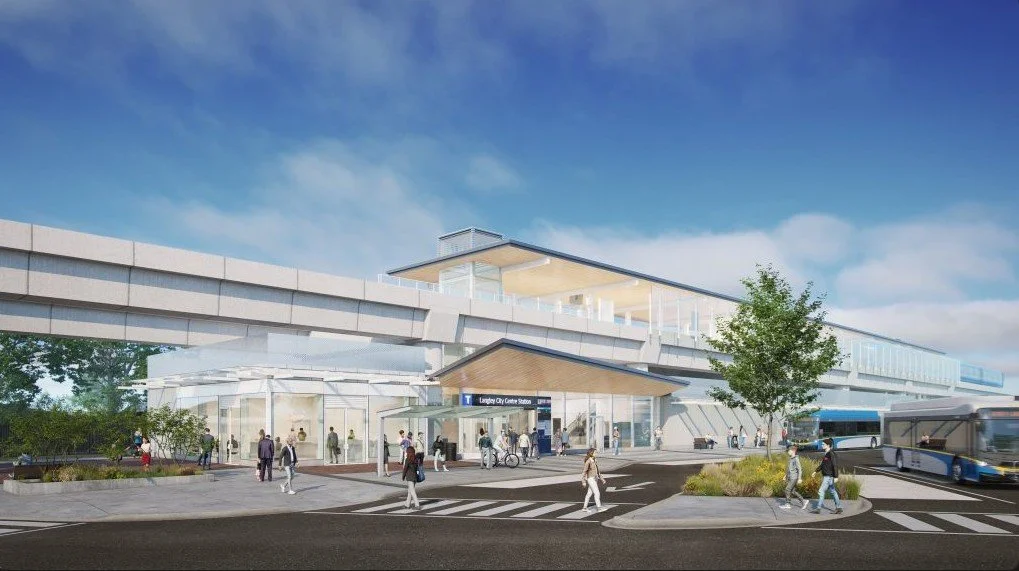
Use an official architectural rendering of Willowbrook Station to give readers a visual break from construction photography and show what the finished project is expected to look like. Willowbrook is also important because it will include one of the extension's three new transit exchanges.
56,000 Riders in the Opening Year
The province expects approximately 56,000 passengers to use the extension each weekday during its opening year.
By 2050, projected weekday ridership could increase to approximately 80,000.
Those figures demonstrate why the project is being built as high-capacity rapid transit rather than simply relying on additional buses.
SkyTrain can scale as demand increases.
Automated operation allows trains to run at high frequencies, while additional vehicles can increase passenger capacity.
The existing system is also receiving upgrades in preparation for expansion.
TransLink is improving propulsion-power infrastructure, station systems, automatic train controls and communications equipment as it prepares for additional passengers and longer trains across the network.
The Surrey Langley extension therefore cannot operate completely independently from the rest of SkyTrain.
Its success depends on the ability of the existing network to absorb tens of thousands of additional daily journeys.
Source: TransLink – SkyTrain Infrastructure Upgrade Projects
Source: Government of British Columbia – New SkyTrain Stations Taking Shape
The Development Boom Around the Stations
The most significant effects of the Surrey Langley SkyTrain may eventually occur outside the railway itself.
Rapid transit changes the economics of land.
Property that once required a car or lengthy bus journey can suddenly sit within walking distance of a regional transportation system.
That accessibility makes land around stations attractive for housing, offices, retail and other development.
Metro Vancouver has already witnessed this pattern.
SkyTrain stations throughout Burnaby, Coquitlam, New Westminster and Surrey have become focal points for increasingly dense development.
Something similar is likely along Fraser Highway.
The effect could be particularly significant around Fleetwood, Clayton, Willowbrook and Langley City Centre.
Instead of expanding endlessly outward with low-density development, municipalities have an opportunity to concentrate thousands of new homes within walking distance of high-capacity transit.
The Surrey Langley SkyTrain could therefore become as much a city-building project as a transportation project.
The provincial government itself describes the extension as a catalyst for transit-oriented development around stations and transit exchanges.
That development could include housing, employment, retail, commercial space and public amenities.
Use a photograph showing rows of completed concrete guideway segments at the project's precast facility. This gives readers a behind-the-scenes view of how an elevated railway is actually manufactured. The project's precast facility at 195 Street and 24 Avenue in Surrey produces segments before they are transported to Fraser Highway for installation.
The Economic Impact of the Project
The construction program itself is enormous.
The provincial government estimates the Surrey Langley SkyTrain will support approximately 26,700 direct and indirect jobs.
Those positions stretch across multiple industries.
Engineers design structures and transportation systems.
Construction workers install foundations, columns and guideways.
Concrete facilities manufacture precast segments.
Electricians build power systems.
Rail specialists install track.
Technology contractors integrate automated train controls and communications infrastructure.
But the project's longer-term economic impact could be considerably larger.
Improved transportation allows employers to draw workers from a wider geographic area.
Residents gain access to more jobs without necessarily owning a vehicle.
Businesses around stations gain additional pedestrian traffic.
Developers gain opportunities to construct housing and commercial projects around major transportation hubs.
The railway becomes economic infrastructure.
Source: Government of British Columbia – Surrey Langley SkyTrain Construction Milestone
A New Centre of Gravity for Metro Vancouver
Perhaps the most important thing about the Surrey Langley SkyTrain is what it says about Metro Vancouver itself.
The region is changing.
Population growth is no longer concentrated around Vancouver's traditional urban core.
Surrey is becoming an increasingly important employment, residential and institutional centre.
Langley continues expanding.
Communities south of the Fraser are absorbing a substantial share of the region's new population.
Transportation infrastructure must eventually respond to that reality.
The Surrey Langley SkyTrain is one of the clearest examples.
A railway once associated primarily with Vancouver, Burnaby and New Westminster will soon extend deep into communities that were overwhelmingly automobile-oriented only a generation ago.
The extension effectively acknowledges that the future Metro Vancouver region will be more geographically distributed than the one that existed when SkyTrain opened in 1985.
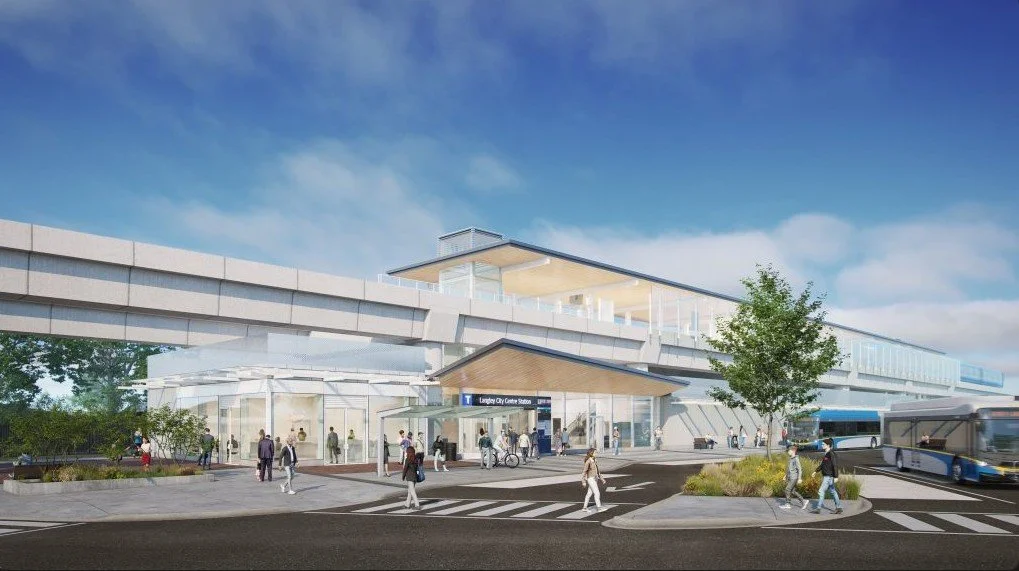
Finish the article with an official rendering of Langley City Centre Station. As the eastern terminus of the 16-kilometre extension, it visually reinforces the article's larger point: SkyTrain is extending beyond Surrey and directly into Langley for the first time. The station is also planned as one of the extension's three major transit exchanges. SkyTrain Surrey-Langley
More Than 16 Kilometres of Concrete and Steel
By late 2029, if the current schedule holds, passengers should be able to enter a station in Langley City Centre and board an automated train heading directly toward Surrey and the wider Metro Vancouver rapid-transit network.
The journey to King George Station is expected to take approximately 22 minutes.
What is currently one of British Columbia's largest construction corridors will become permanent transportation infrastructure.
The massive concrete columns appearing along Fraser Highway will carry trains for decades.
Construction sites will become stations.
Temporary lane closures will disappear.
Land surrounding those stations will likely fill with new housing, businesses and public spaces.
And communities that spent decades waiting for rapid transit will finally become directly connected to the SkyTrain network.
At nearly $6 billion, the Surrey Langley SkyTrain is an enormous investment.
But its true scale cannot be measured only in kilometres of guideway or billions of dollars.
It represents an attempt to prepare Metro Vancouver for where hundreds of thousands of future residents will live and work.
The region south of the Fraser River is growing rapidly.
Now, after decades of debate, the rapid-transit network is finally growing with it.
Sources
Surrey Langley SkyTrain – Official Project Website
Government of British Columbia – Surrey Langley SkyTrain Project Overview
Surrey Langley SkyTrain – Current Construction Work
Government of British Columbia – New SkyTrain Stations Taking Shape
Government of British Columbia – Surrey Langley SkyTrain Cost and Schedule Update
Government of Canada – New SkyTrain Stations Taking Shape for Transit Riders South of the Fraser
TransLink – Surrey Langley SkyTrain
TransLink – Surrey Langley SkyTrain Business Case
