

Seine-Nord Europe Canal: Inside France’s €7.3 Billion Waterway Megaproject
By BuildBrief News Desk
Across northern France, one of Europe’s most ambitious pieces of transportation infrastructure is beginning to emerge from farmland, river valleys and construction sites.
The Seine-Nord Europe Canal is a 107-kilometre inland waterway being built between Compiègne, north of Paris, and Aubencheul-au-Bac near Cambrai. Once completed, the canal will create a high-capacity shipping connection between the Seine basin and the large inland-waterway networks of northern France, Belgium and the Netherlands.
It is difficult to overstate the strategic importance of the project. France possesses some of Europe’s most important rivers and ports, yet a longstanding gap in its high-capacity inland-waterway network has limited the ability of large freight vessels to travel efficiently between the Paris region and northern Europe.
The Seine-Nord Europe Canal is designed to eliminate that bottleneck.
The new waterway will be capable of accommodating large European Class Vb vessels and convoys carrying thousands of tonnes of cargo. In practical terms, that means commodities and containerized freight that might otherwise travel aboard dozens or even hundreds of trucks could instead move aboard a single vessel.
But the project has also become considerably more expensive and complicated than originally anticipated.
In January 2026, the Société du Canal Seine-Nord Europe announced that the target cost at completion had been reassessed at approximately €7.3 billion. Construction is now progressing across several sections of the route, while the project’s official calendar currently anticipates commissioning in 2032 following testing and inspections.
For France, the canal represents far more than 107 kilometres of water.
It is an attempt to fundamentally reshape how freight moves between Paris, northern France and some of Europe’s largest ports.
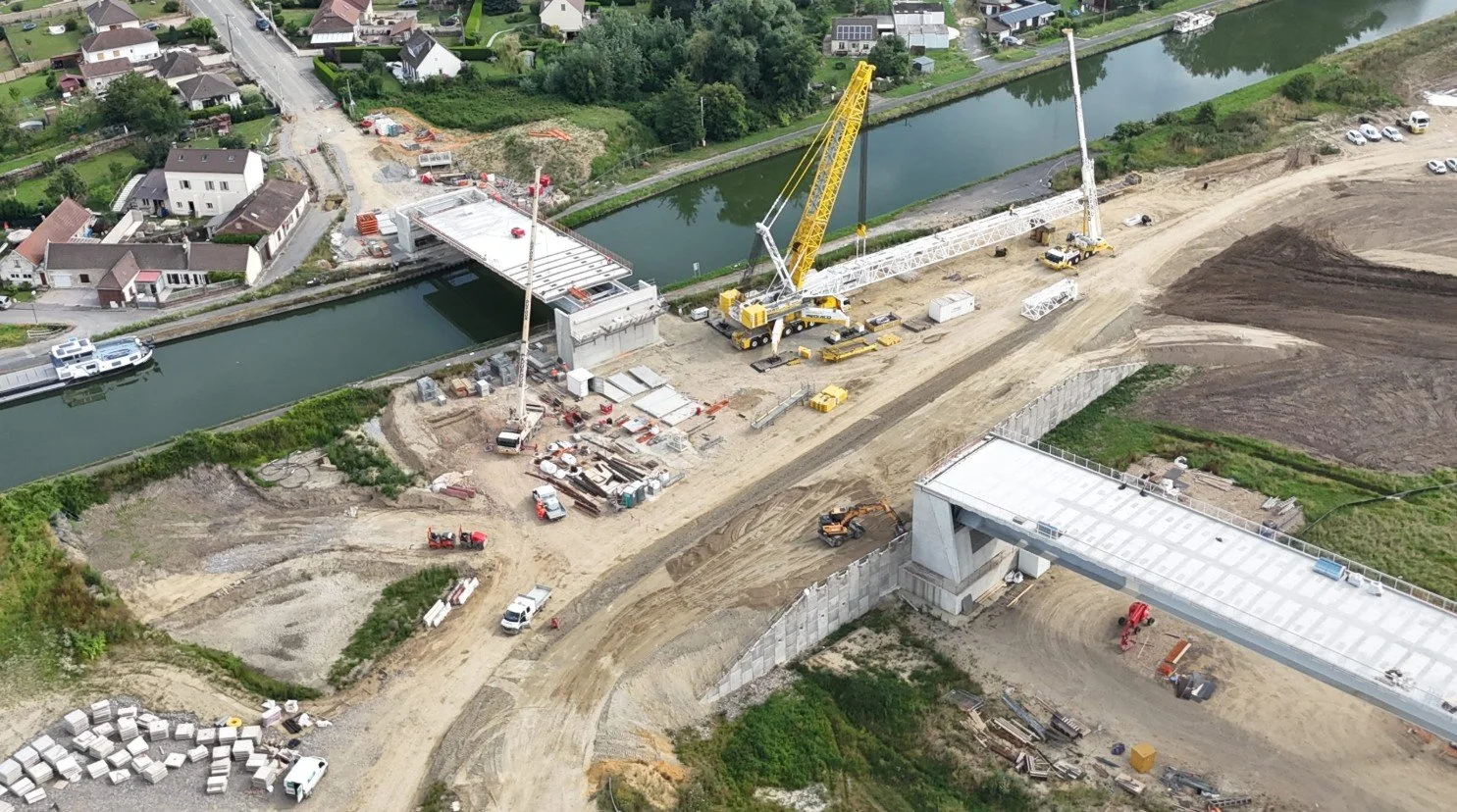
Use a wide aerial photograph showing the construction corridor, earthworks, bridges and surrounding landscape. This would be my featured image because it immediately communicates the extraordinary physical scale of the 107-kilometre project.
The Missing Link in Europe’s Waterway Network
Europe already possesses an extraordinary system of navigable rivers and canals.
The Rhine, Scheldt, Meuse and other waterways form a vast freight network connecting industrial regions with major ports including Rotterdam and Antwerp. Barges move containers, agricultural products, construction materials, chemicals and other commodities across the continent.
France is connected to this system, but imperfectly.
The Seine provides a major freight corridor between Paris and the English Channel, including access to the Port of Le Havre. Northern France also possesses navigable waterways connected with Belgium and the wider European network.
Between those systems, however, lies a major capacity constraint.
Existing waterways cannot efficiently accommodate the largest modern European inland vessels across the entire north-south route. The Seine-Nord Europe Canal is designed to close that gap.
According to the European Investment Bank, the project forms the central link in the larger cross-border Seine-Scheldt project connecting the Trans-European Transport Network waterways of the Seine and Scheldt basins.
That wider context matters.
The canal is not simply a French infrastructure project. It is part of an international transportation corridor intended to connect French economic centres with Belgium, the Netherlands and some of the largest maritime gateways on Earth.
Once completed, freight originating around Paris could travel by high-capacity inland waterway toward Belgium and ultimately toward ports including Antwerp and Rotterdam.
Cargo moving in the opposite direction could reach the Seine basin and continue toward the Paris region.
The result would be a new freight artery stretching across northwestern Europe.
107 Kilometres of New Canal
The scale of the physical project is enormous.
The Seine-Nord Europe Canal will extend approximately 107 kilometres between Compiègne and Aubencheul-au-Bac.
But describing the project simply as a canal understates the engineering involved.
According to the official Seine-Nord Europe Canal project, the route includes seven locks, three canal bridges and more than 1,200 hectares of plantations and environmental developments.
One of those structures will be particularly extraordinary.
The Pont-Canal de la Somme will carry the new canal across the Somme Valley on a structure approximately 1.33 kilometres long.
Instead of a road or railway crossing above water, the structure will essentially carry a navigable waterway through the air.
Large commercial vessels will travel across a constructed channel supported above the landscape below.
It will be one of the project’s most visually dramatic engineering features and a reminder that building a modern canal requires much more than excavation.
Roads must be relocated or bridged.
Existing waterways must be crossed.
Railways must be accommodated.
Locks must overcome changes in elevation.
Water-management systems must maintain navigable depths while limiting the environmental effects of operating an enormous artificial waterway.
The canal must also be capable of supporting industrial-scale shipping for generations.
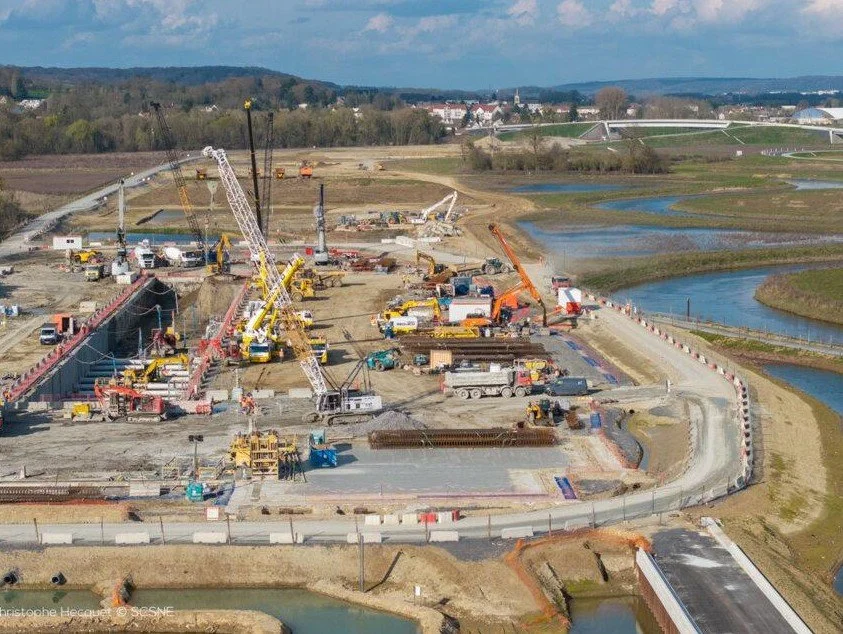
An aerial or elevated photograph of the Montmacq–Cambronne-lès-Ribécourt lock construction site would work perfectly beside the section explaining the canal's locks. Recent work has included construction of the lock's diaphragm walls and other major civil-engineering elements. Canal Seine Nord Europe
The Barges the Canal Is Designed to Carry
The economic argument for the Seine-Nord Europe Canal revolves around capacity.
Large inland vessels can move extraordinary quantities of freight using comparatively little space.
The new canal is being built to European Class Vb standards, allowing significantly larger vessels and pushed convoys than those accommodated by many existing waterways along the route.
The European Union’s implementing decision for the Seine-Scheldt project specifies that the Seine-Nord Europe connection is to be built to ECMT Class Vb standards and capable of supporting three layers of containers.
That capability could make inland shipping considerably more competitive for certain freight movements.
A single large vessel can replace a substantial number of trucks, particularly for bulk cargo and high-volume freight.
The attraction is not difficult to understand.
European highways already carry enormous freight volumes. Adding population, economic activity and international trade creates pressure for even more road capacity.
Canals provide an alternative.
They will not replace trucks, nor are they intended to. Trucks remain essential for flexible and short-distance deliveries.
Instead, inland waterways can absorb portions of long-distance freight movement where large volumes are travelling between predictable industrial and logistics hubs.
The Seine-Nord Europe Canal is effectively being constructed as a high-capacity freight highway — except the vehicles will be barges.
A €7.3 Billion Megaproject
Projects of this scale rarely remain financially static.
The Seine-Nord Europe Canal is no exception.
The 2019 financing agreement was based on a project cost of approximately €5.1 billion in then-current terms, derived from technical estimates developed during earlier studies.
By January 2026, that figure had changed significantly.
The Société du Canal Seine-Nord Europe reported that the target cost at the end of construction had been reassessed at approximately €7.3 billion.
The increase reflects several factors.
Years have passed since earlier estimates were developed. Detailed engineering has advanced. Environmental requirements and technical standards have evolved. Inflation has increased construction costs, while the project schedule itself has changed.
According to the project authority, when measured in constant 2016 euros, the increase is considerably smaller than the headline difference suggests, at approximately 20%.
Nevertheless, €7.3 billion places the canal firmly among Europe’s major contemporary infrastructure programs.
Financing is shared between France, regional and local authorities and the European Union.
The 2019 agreement included approximately €1.1 billion from the French state and another €1.1 billion from participating local authorities, including the Hauts-de-France and Île-de-France regions and several departments.
European funding is also critical.
The European contribution through the Connecting Europe Facility was initially based on funding approximately 40% of eligible works. That rate was subsequently increased to 50%, according to the project authority, with €868 million secured through the end of 2027.
The scale of European participation reflects the fact that the canal’s economic importance extends well beyond France.
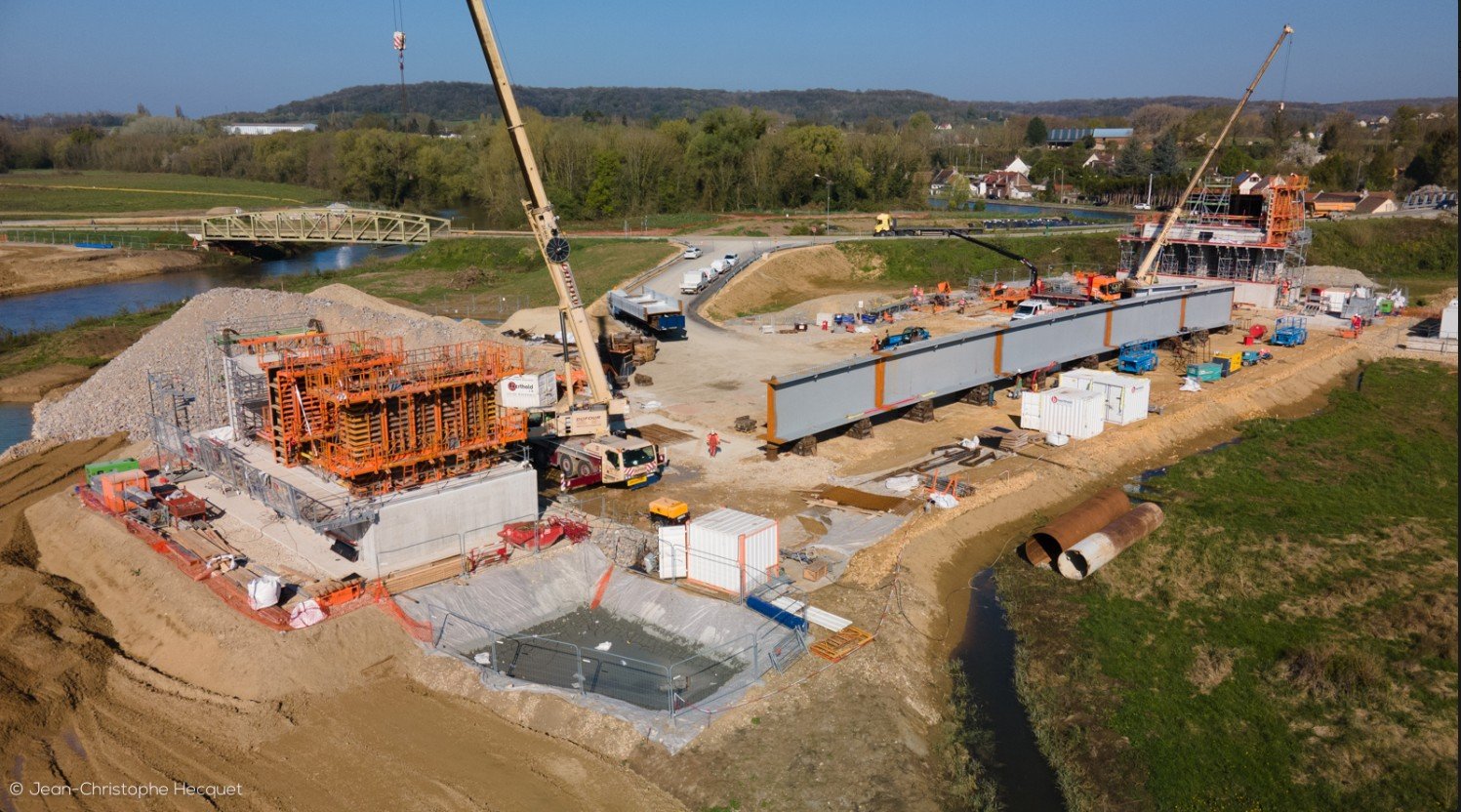
Choose an aerial photograph showing the steel bridge structure and surrounding construction. The RD66 works provide a strong visual explanation of how existing roads have to be rebuilt or carried across the future waterway. The official project documented construction of the abutments, central span and steel framework.
Construction Enters a New Phase in 2026
For years, the Seine-Nord Europe Canal existed largely as an enormous planning, environmental and political exercise.
That period is ending.
Construction activity has accelerated substantially.
According to the official project’s 2026 news and construction updates, major works have been progressing on multiple parts of the alignment.
One of the most significant developments came in April 2026, when the principal construction contract for Sector 1 was notified. That package covers the first major stretch of the canal between Compiègne and Passel in the Oise Valley.
The project authority describes 2026 as a turning point, with construction of the first 18 kilometres entering its principal execution phase.
The work involves considerably more than digging a channel.
Mass earthmoving is required to establish the canal’s geometry. Bridges and other structures must be constructed or modified. Existing roads and connections need to be restored around the new infrastructure.
Meanwhile, lock construction is progressing.
At Montmacq, civil-engineering work on one of the canal’s major locks continued through 2026. Further north, construction activity has expanded into the Artois-Cambrésis area.
On June 9, 2026, work associated with the Oisy-le-Verger lock marked another major milestone, bringing large-scale construction into the Nord-Pas-de-Calais section of the project.
The Société du Canal Seine-Nord Europe now describes active works occurring across an increasingly broad portion of the future canal.
For communities along the route, the megaproject is becoming physical.
The Extraordinary Somme Canal Bridge
Among all of the canal’s engineering works, one structure is likely to become its architectural symbol.
The Pont-Canal de la Somme will carry the canal across the Somme Valley.
At approximately 1.33 kilometres long, it represents one of the most technically ambitious components of the project.
The concept is remarkable.
The bridge must support not merely vehicles or trains but an enormous volume of water and the commercial vessels travelling through it.
The structure therefore has to withstand permanent hydraulic loads while providing a reliable navigation channel above the landscape.
The project authority reported in June 2026 that the selected design followed nearly three years of studies and technical discussions. The design-build contract for Sector 6, which includes the Somme canal bridge, its northern and southern approach areas and associated structures, was awarded during 2026.
Details of that contract are documented in the French public procurement notice for Sector 6.
Once constructed, the bridge could become one of the defining images of the entire Seine-Nord Europe project.
It will also demonstrate the sheer engineering effort required to maintain a navigable canal across complicated terrain.
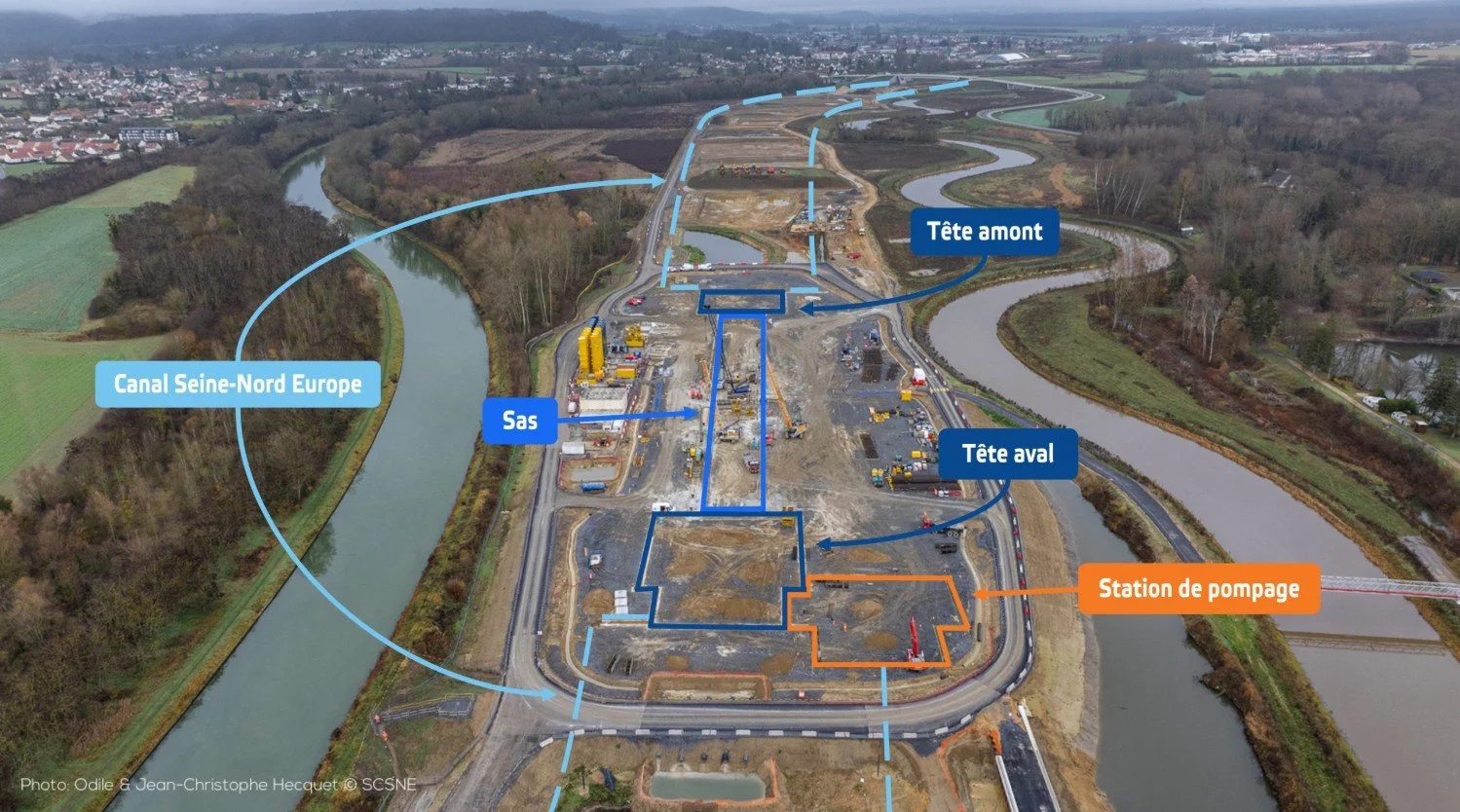
Use an aerial photograph showing the reshaped Oise River near Montmacq. This is an especially valuable image because it demonstrates that the project involves far more than simply excavating a canal. The works included moving the Oise into a new channel as engineers prepared the surrounding corridor for the new waterway. Canal Seine Nord Europe
Moving Freight Away From Roads
The strategic purpose behind all this concrete, excavation and hydraulic engineering is freight.
France and the wider European Union have been attempting to diversify transportation away from overwhelming dependence on road haulage.
Heavy trucks provide extraordinary flexibility, but large freight volumes also contribute to highway congestion, infrastructure wear, emissions and pressure for additional road capacity.
Railways offer one alternative.
Inland waterways offer another.
The Seine-Nord Europe Canal is intended to make waterborne freight significantly more competitive between the Seine basin and northern Europe.
The economic logic is particularly strong for heavy and high-volume commodities.
Construction materials, grain, aggregates, metals and containers can move efficiently aboard large vessels when suitable waterways and terminals exist.
But infrastructure alone does not guarantee freight will transfer from roads.
Ports and logistics terminals must be available.
Businesses need reliable schedules.
Warehouses and industrial facilities must connect efficiently with the waterway.
The canal therefore represents only one component of a larger freight ecosystem.
Its ultimate success will be measured not by the amount of water in the channel but by how much cargo actually moves through it.
A Canal Built Around Environmental Constraints
Constructing a 107-kilometre artificial waterway inevitably creates environmental consequences.
The canal crosses agricultural areas, river systems, wetlands and wildlife habitats.
That has forced planners to incorporate environmental mitigation into the project on an unusually large scale.
The official project identifies more than 1,200 hectares of plantations and environmental development associated with the canal.
New ponds, ecological habitats and landscaping are being created in various areas, while construction planning must account for water management and biodiversity.
Environmental authorization has also played a significant role in the project schedule.
Obtaining the final environmental authorization in August 2024 provided the project authority with a more complete understanding of the engineering and regulatory requirements across the entire route.
That milestone subsequently contributed to schedule and cost reassessments.
The challenge illustrates a reality facing virtually every modern megaproject.
Infrastructure can no longer be planned purely around engineering efficiency.
Environmental impact, habitat restoration, carbon emissions, agricultural land and community disruption are now fundamental components of project design.
For the Seine-Nord Europe Canal, those considerations affect thousands of hectares.
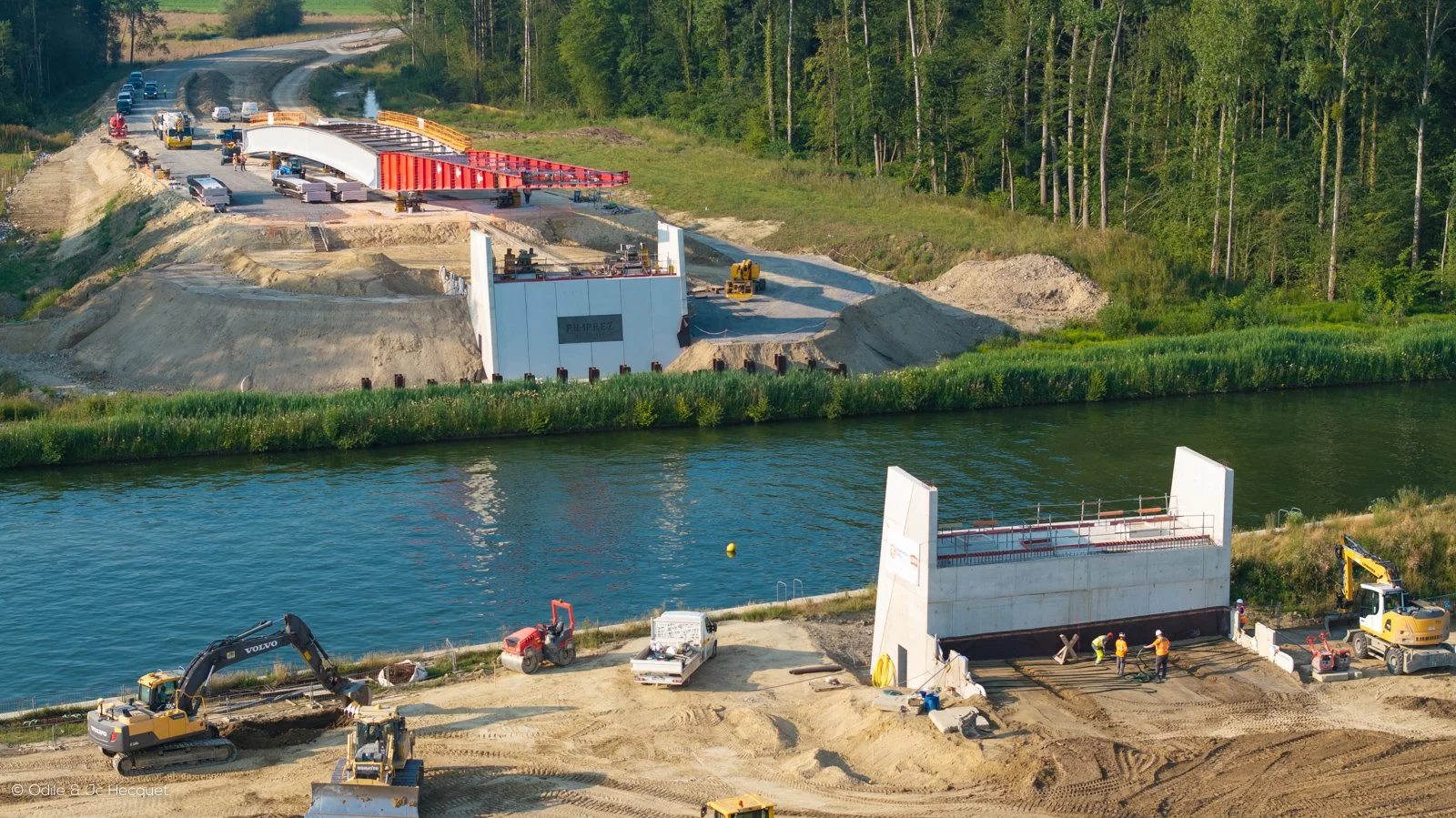
A photograph of the RD40bis bridge being launched or assembled at Pimprez gives the article another dramatic heavy-construction image. Official project photography documents the steel structure, bridge launching operation, embankments and concrete deck construction.
The Water Problem Behind a Giant Canal
A canal of this scale requires enormous quantities of water.
That creates another engineering challenge.
Locks work by raising and lowering vessels between different water elevations. Every locking cycle moves water through the system.
On a heavily used commercial canal, those movements can become substantial.
Designing the Seine-Nord Europe Canal therefore requires careful management of water resources, particularly as Europe confronts increasingly unpredictable periods of drought and extreme weather.
Storage and water-management infrastructure form an important part of the overall system.
The canal cannot simply operate under the assumption that unlimited water will always be available.
That challenge may become even more important over the infrastructure’s lifespan.
The canal is being designed for decades of operation, meaning engineers must consider climate conditions that could differ significantly from those experienced when the project was originally conceived.
Why Europe Cares About the Project
The European Union’s financial involvement is not merely political support for a French construction project.
The Seine-Nord Europe Canal sits within a much larger European transportation strategy.
The European Commission’s 2024 implementing decision identifies the canal as part of the cross-border Seine-Scheldt project.
The broader corridor connects France with Belgium and the Netherlands through an interconnected system of inland waterways.
For European transportation planners, the project helps create redundancy and capacity within the continent’s freight network.
That matters economically and strategically.
Europe depends heavily on major ports including Rotterdam, Antwerp-Bruges and Le Havre. Efficient inland connections determine how quickly cargo can move between those ports and industrial or consumer markets.
A high-capacity inland waterway connecting the Paris region with northern Europe could create new routing options for businesses throughout the region.
The canal therefore becomes part of a continental logistics system rather than merely a regional French waterway.
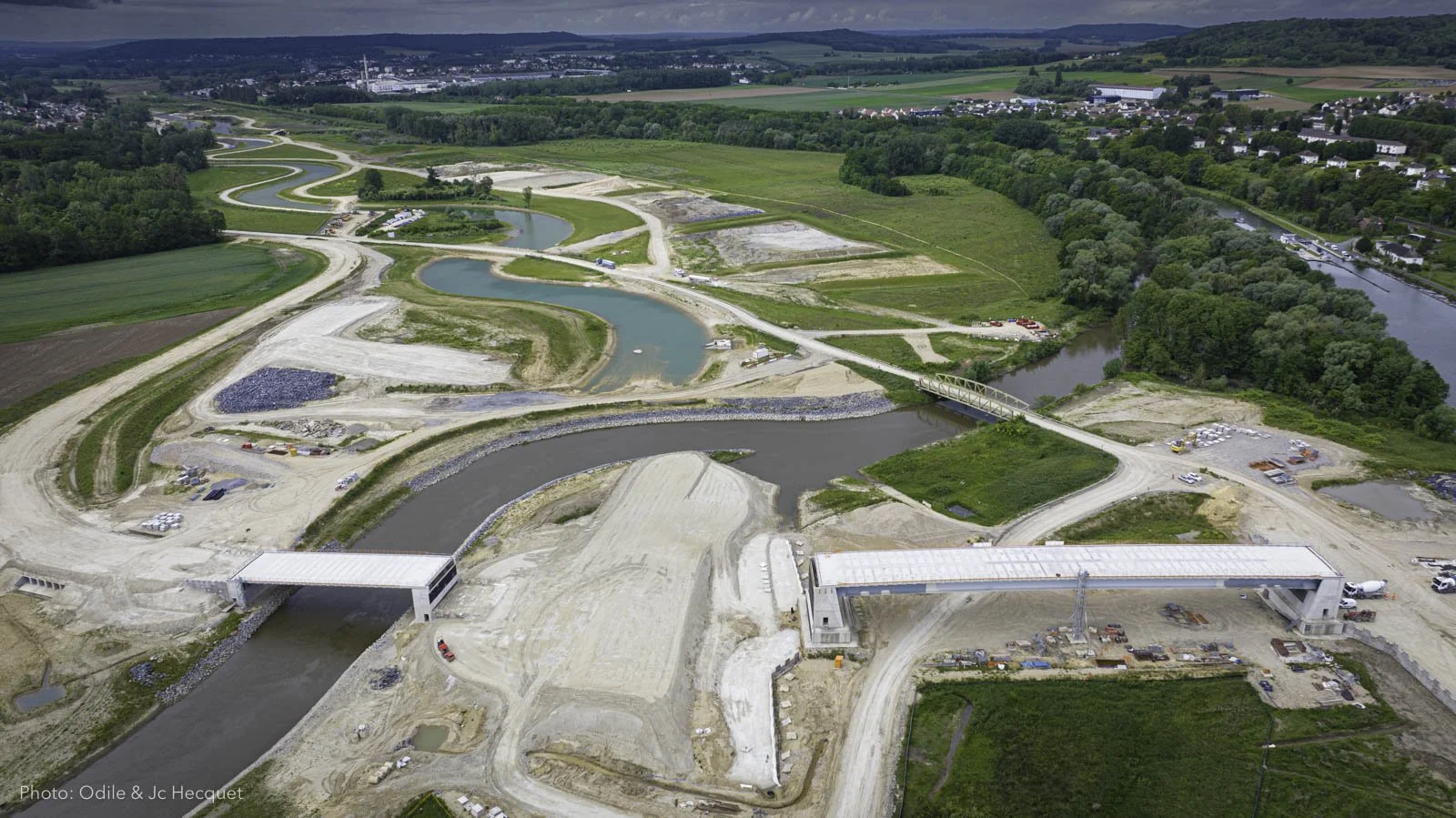
Use the aerial view showing the RD66 bridges across the Oise, future canal corridor and Canal Latéral à l'Oise. It provides one of the clearest images for explaining the complexity of fitting the new waterway into an existing transportation and river system. Canal Seine Nord Europe
The Long Road Toward 2032
Megaprojects frequently demonstrate the difference between political announcements and physical construction.
The Seine-Nord Europe Canal has spent decades moving through planning, financing, redesign and environmental approval.
Schedules have changed along the way.
A previous European implementation framework anticipated operation considerably earlier. The EU’s updated 2024 decision called for the canal between Compiègne and Aubencheul-au-Bac to be constructed and enter operation as a Class Vb waterway by the end of 2030.
The project authority’s current construction calendar, however, states that commissioning is planned for 2032 following approximately six months of inspections and testing.
The official Seine-Nord Europe Canal construction calendar divides the project into multiple technical sectors, allowing different components to advance according to their individual design, permitting and construction schedules.
That sequencing is essential.
Locks, bridges, earthworks, hydraulic systems and navigation equipment must ultimately function as one continuous waterway.
Digging individual sections is not enough.
Only when the entire system is connected, filled, tested and certified can large commercial vessels begin travelling between the Seine and northern European networks.
A New Freight Artery for Europe
If the Seine-Nord Europe Canal succeeds, its greatest achievement may eventually appear surprisingly ordinary.
A vessel will enter a lock.
Water levels will change.
Gates will open.
The vessel will continue north carrying thousands of tonnes of cargo.
That process will repeat thousands of times.
The spectacular construction sites, giant earthmoving machines and multibillion-euro financing agreements will gradually disappear from public attention.
What remains will be infrastructure.
The canal could operate for generations, quietly carrying freight between some of Europe’s largest economic regions.
Its 107 kilometres of waterway will connect transportation systems that have remained constrained by incompatible dimensions and limited capacity.
Its locks will lift enormous vessels across the northern French landscape.
Its canal bridges will carry water and ships above existing valleys and waterways.
And its logistics connections could provide businesses with an alternative to putting another truck onto an already crowded highway.
At approximately €7.3 billion, the Seine-Nord Europe Canal is an enormous gamble on the future of inland freight.
Construction still has years to run, costs have increased and the engineering challenges remain substantial.
But in 2026, the project has crossed an important threshold.
The canal is no longer primarily something being debated on maps.
Across northern France, it is being built.
And when the first large commercial vessels eventually travel the full route, France will have completed one of the most consequential transformations of its transportation network in generations.
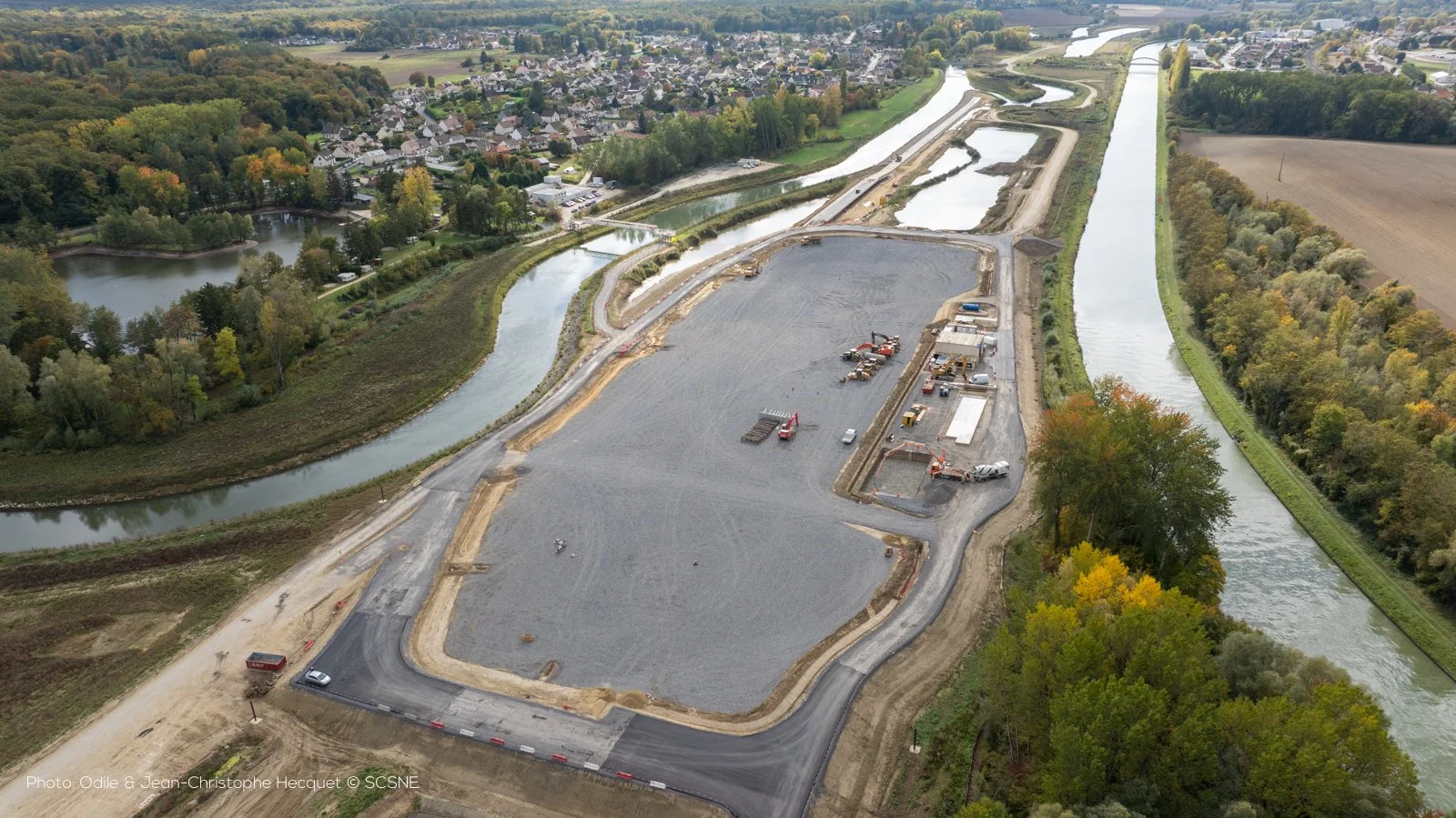
For the final image, use the official aerial photograph showing the Montmacq lock construction area together with the completed RD66 bridges. It works particularly well near the conclusion because readers can see finished infrastructure alongside the enormous construction zone where the canal itself is continuing to take shape.
Sources
Canal Seine-Nord Europe – Official Project Website
Canal Seine-Nord Europe – Cost and Financing: Where Do We Stand?
Canal Seine-Nord Europe – Official Project Calendar
Canal Seine-Nord Europe – News and Construction Updates
European Investment Bank – Canal Seine Nord Project
French Government – Ministry for Ecological Transition, Infrastructure Project Assessment
French Government – Oise Prefecture, Canal Seine-Nord Europe Project Updates
France Marchés – Seine-Nord Europe Canal Sector 6 and Somme Canal Bridge Contract
European Union – Trans-European Transport Network and Seine-Scheldt Corridor
