

Egypt’s ‘New Nile’: Inside the Massive Water Project Reshaping the Desert West of Cairo
By BuildBrief News Desk
For thousands of years, the geography of Egypt has been dictated by one immovable fact: where the Nile flows, civilization follows.
Almost the entire population of the country lives along the river, its delta, or the narrow bands of fertile land created by its waters. Beyond those boundaries, the landscape quickly gives way to desert. Egyptian cities, farms and transportation networks have consequently developed around a river system whose basic geography has remained recognizable since antiquity.
Now, Egypt is attempting something radically different.
A vast water infrastructure program west of Cairo is designed to carry Nile water and enormous volumes of treated agricultural drainage water into the desert as part of the country's New Delta development. At the center of the plan is a water corridor popularly described as a "New Nile"—a new artificial waterway intended to support agricultural expansion while also becoming a defining feature of Jirian, a major new city planned west of Cairo.
The scale is extraordinary. Approximately 10 million cubic meters of Nile water per day is expected to be directed toward the wider development, according to reporting by Reuters, while a separate water system will deliver as much as 7.5 million cubic meters of treated agricultural drainage water per day.
Together, the projects reveal a larger Egyptian strategy: rather than accepting that population growth must remain concentrated around the historic Nile Valley and Delta, the government is attempting to build the infrastructure necessary to move development outward.
It is an engineering project, an agricultural project and an urban-development project simultaneously.
But in one of the world's most water-stressed countries, redirecting Nile water into the desert also raises an unavoidable question.
Can Egypt afford to create a new Nile while fighting to protect every drop of the original one?
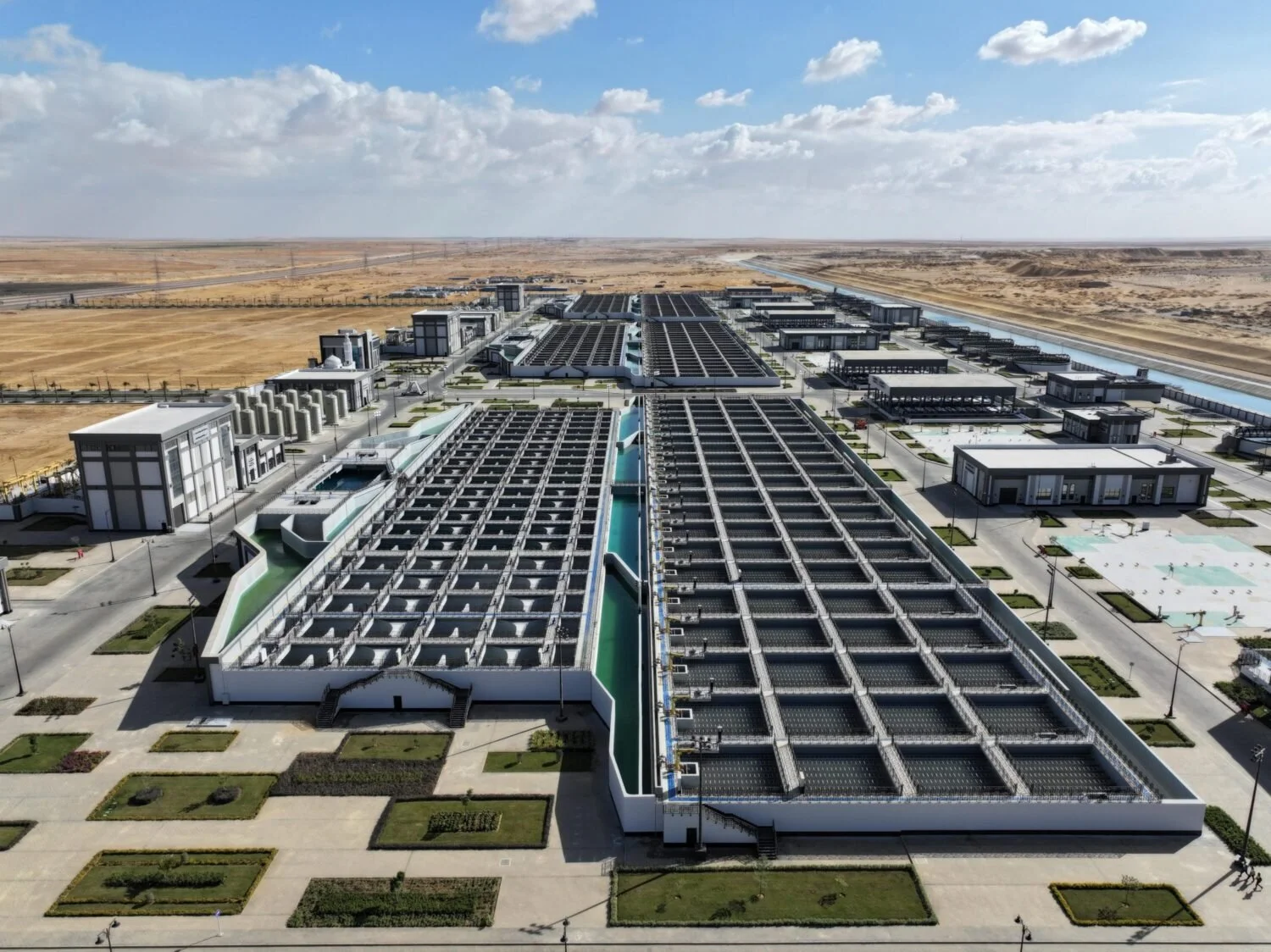
A sweeping aerial view of the New Delta Irrigation Water Treatment Plant in Egypt. The massive facility is designed to treat approximately 7.5 million cubic meters of agricultural drainage water per day, forming a critical component of Egypt’s effort to expand agriculture into the Western Desert.
A New River Through the Desert
The project became internationally prominent in June 2025 when the Egyptian government announced Jirian, a massive development approximately 42 kilometers west of central Cairo.
Jirian—whose name is derived from the Arabic word for "flow"—is planned as a 6.8-million-square-meter development along the Sheikh Zayed Axis. The project is being developed through cooperation between the Egyptian state, represented by the Future of Egypt Authority for Sustainable Development, and private developers Nations of Sky, Palm Hills Developments and Mountain View.
Unlike conventional desert developments, however, Jirian is being designed around water.
Plans call for a newly created Nile-linked waterway to travel through the development before continuing toward the much larger New Delta agricultural zone.
The concept effectively reverses Egypt's traditional development pattern.
Historically, Egyptians built settlements where water already existed. With the New Delta infrastructure, Egypt is attempting to bring water to areas where it wants settlements and agriculture to exist.
Reuters reported that approximately 10 million cubic meters of Nile water could move through the system every day, equivalent to roughly 7 percent of Egypt's officially allocated annual Nile share when measured against the country's longstanding 55.5-billion-cubic-meter annual allocation.
That does not necessarily mean the entire volume will be consumed by Jirian.
The urban project is positioned along a larger water route intended to ultimately support agricultural development across the New Delta. The city is therefore better understood as one component positioned along a much larger piece of national water infrastructure.
Still, the numbers demonstrate the enormous scale involved.
Source: Reuters
https://www.reuters.com/sustainability/land-use-biodiversity/egypt-plans-desert-city-supplied-with-diverted-nile-water-2025-06-01/
The New Delta Is the Bigger Story
Jirian may attract attention because of its waterfront homes, marina and striking concept of a Nile waterway crossing the desert, but the larger New Delta project is primarily about agriculture.
Egypt has spent years attempting to increase the amount of cultivable land available to a rapidly growing population.
The New Delta represents one of the country's largest attempts yet.
Government descriptions have placed the broader development at roughly 2.2 million to 2.5 million feddans or acres depending on the specific phase and land included in official presentations. The enormous agricultural zone stretches west of the traditional Nile Delta into territory that historically could not support intensive agriculture without major water infrastructure.
President Abdel Fattah El-Sisi formally inaugurated the integrated New Delta agricultural development project in May 2026, highlighting how quickly the initiative has moved from an ambitious desert-reclamation proposal toward functioning national infrastructure.
The objective is straightforward: increase domestic agricultural production, reduce dependence on imported food and create entirely new economic corridors outside Egypt's crowded traditional agricultural regions.
Egypt is particularly vulnerable to fluctuations in global food prices. The country is one of the world's major wheat importers, making domestic agricultural capacity an issue of national economic security as much as food production.
New farmland, however, requires water.
And that is where the project's most impressive engineering becomes visible.
Source: Presidency of the Arab Republic of Egypt
https://www.presidency.eg/EN/%D9%82%D8%B3%D9%85-%D8%A7%D9%84%D8%A3%D8%AE%D8%A8%D8%A7%D8%B1/%D8%A3%D8%AE%D8%A8%D8%A7%D8%B1-%D8%B1%D8%A6%D8%A7%D8%B3%D9%8A%D8%A9/news1752026/
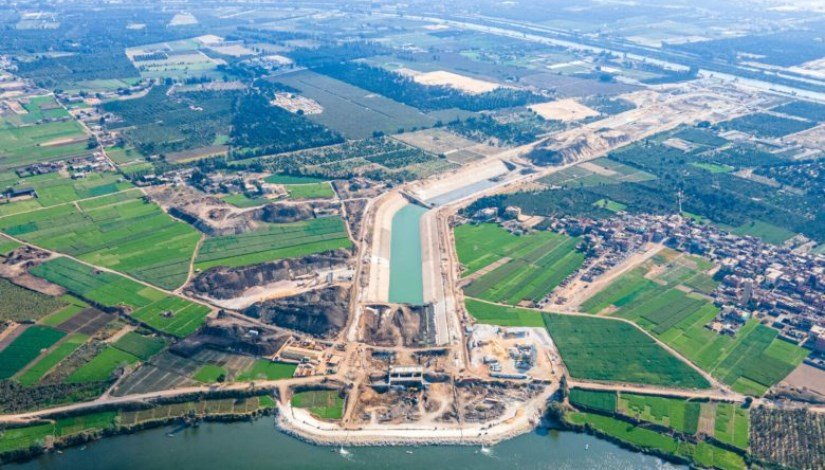
An aerial view showing major canal infrastructure associated with Egypt’s effort to transport enormous quantities of water westward toward new agricultural developments. The water network illustrates the scale of engineering required to expand intensive agriculture beyond the traditional Nile Valley and Delta.
7.5 Million Cubic Meters of Recycled Water Every Day
Egypt cannot simply continue withdrawing enormous new quantities of freshwater from the Nile.
Instead, a significant portion of the New Delta's water strategy revolves around reuse.
The Ministry of Water Resources and Irrigation has been developing a massive system for collecting agricultural drainage water from the western Delta and transporting it to the New Delta treatment facility.
The system includes a network of pumping stations and a conveyance corridor extending roughly 166 kilometers, according to ministry information published in early 2026.
Once treated, the system is designed to provide approximately 7.5 million cubic meters of water every day.
That figure is important.
Instead of allowing drainage water to become effectively unusable or discharge elsewhere, Egypt is attempting to capture it, treat it to an appropriate standard and return it to productive agricultural use.
It is essentially water recycling at national infrastructure scale.
The Ministry of Water Resources and Irrigation reported in January 2026 that construction of the western Delta agricultural drainage conveyance route to the New Delta treatment plant had reached approximately 78 percent completion.
The ministry described the system as consisting of 12 pumping stations and the approximately 166-kilometer conveyance route, intended to support reclamation of roughly 362,000 feddans.
Source: Egypt Ministry of Water Resources and Irrigation
https://www.mwri.gov.eg/?p=32310
A Chain of Pumping Stations Across the Desert
Moving millions of cubic meters of water is considerably more complicated than excavating a canal.
Water must overcome differences in elevation while maintaining sufficient flow across enormous distances. That requires pumping stations, pipelines, canals, electrical infrastructure and sophisticated control systems working together.
Egypt's Ministry of Water Resources and Irrigation describes the Dabaa Axis/New Delta water project as a collection and transportation system for agricultural and other drainage water with an ultimate capacity of approximately 7.5 million cubic meters per day.
The ministry's project description identifies 13 pumping facilities, including 12 sequential lifting stations and a purification station.
The infrastructure collects water from multiple sources before pushing it toward treatment and ultimately toward reclaimed agricultural territory.
The result is closer to a regional water transportation network than a traditional irrigation canal.
Every pumping station becomes part of an interconnected hydraulic chain.
If one portion cannot deliver the required capacity, agricultural land farther downstream could be affected. Consequently, electrical supply, pumping reliability, maintenance access and water-quality monitoring become critical elements of the system.
Source: Egypt Ministry of Water Resources and Irrigation
https://www.mwri.gov.eg/?page_id=32239
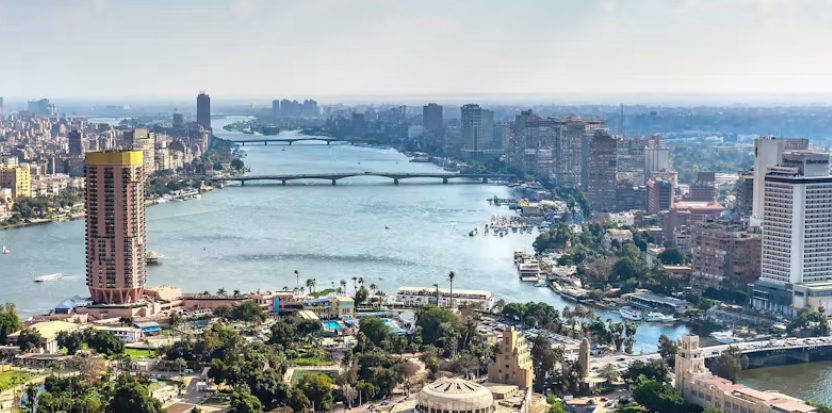
The Nile River winds through the heart of Cairo, illustrating the extraordinary concentration of Egyptian development around the country's primary freshwater resource. Egypt’s New Delta strategy seeks to extend development westward by constructing infrastructure capable of transporting water into historically arid territory.
Egypt's Water Recycling Strategy Is Expanding
The New Delta facility is not an isolated project.
Egypt has increasingly turned toward large-scale water recycling as pressure on freshwater resources grows.
Another enormous example is the Bahr El-Baqar water treatment project, which processes agricultural drainage water for reuse in development projects in Sinai.
The country's strategy increasingly resembles a circular water system: freshwater enters cities and farms, drainage water is collected, treated and moved toward new agricultural territory where it can be used again.
The approach cannot create water from nothing.
Treatment requires substantial energy, infrastructure and maintenance, and salinity can become an important concern when agricultural drainage water is repeatedly reused.
But every cubic meter successfully recycled represents a cubic meter that potentially does not need to be taken directly from another freshwater source.
For a country facing chronic water scarcity, that distinction matters enormously.
Then Came Jirian
The water infrastructure supporting agricultural expansion created another opportunity.
If a major water corridor was already moving toward the New Delta, Egyptian planners saw the possibility of integrating urban development along the route.
The result was Jirian.
The government announced the project in June 2025 as the first major real estate development within the New Delta region.
Prime Minister Mostafa Madbouly described the partnership as part of a broader effort to use state-owned assets more effectively while involving private developers in national development.
The initial Jirian development covers approximately 1,600 feddans, with plans calling for residential neighborhoods, commercial areas, services and extensive waterfront development.
Water is not being hidden behind the infrastructure.
It is being made the centerpiece.
Plans envision neighborhoods oriented toward the artificial Nile-linked waterway, effectively giving previously dry desert land something almost unimaginable in historical Egyptian urban planning: newly created Nile frontage.
Source: Egypt State Information Service
https://mediadr.sis.gov.eg/handle/123456789/100282
Turning Infrastructure Into Real Estate
This is where the project becomes particularly interesting from an urban-development perspective.
A canal carrying water to agricultural land has practical value.
A canal surrounded by residential districts, commercial properties and recreational areas can also create enormous real-estate value.
Waterfront property typically commands a premium. Egypt's government and development partners are effectively attempting to capture part of that premium while constructing infrastructure needed for the New Delta.
Reuters reported that Madbouly framed the project as a way of increasing the value of state assets and land through unconventional development ideas.
The approach means Jirian is not simply a city receiving water from the New Delta project.
The water itself becomes part of the city's economic model.
Renderings and development plans envision upscale housing, commercial districts, green areas and a marina integrated around the water.
That combination has inevitably attracted criticism.
In a country experiencing severe water scarcity, images of artificial waterfronts, luxury housing and yachts can appear difficult to reconcile with calls for conservation.
The government's argument is broader: the water corridor is part of infrastructure serving a massive agricultural development, while urban projects positioned along it can help turn desert land into economically valuable property.
Both realities can exist simultaneously.
The project may support strategic agricultural expansion while also creating lucrative private real-estate opportunities.
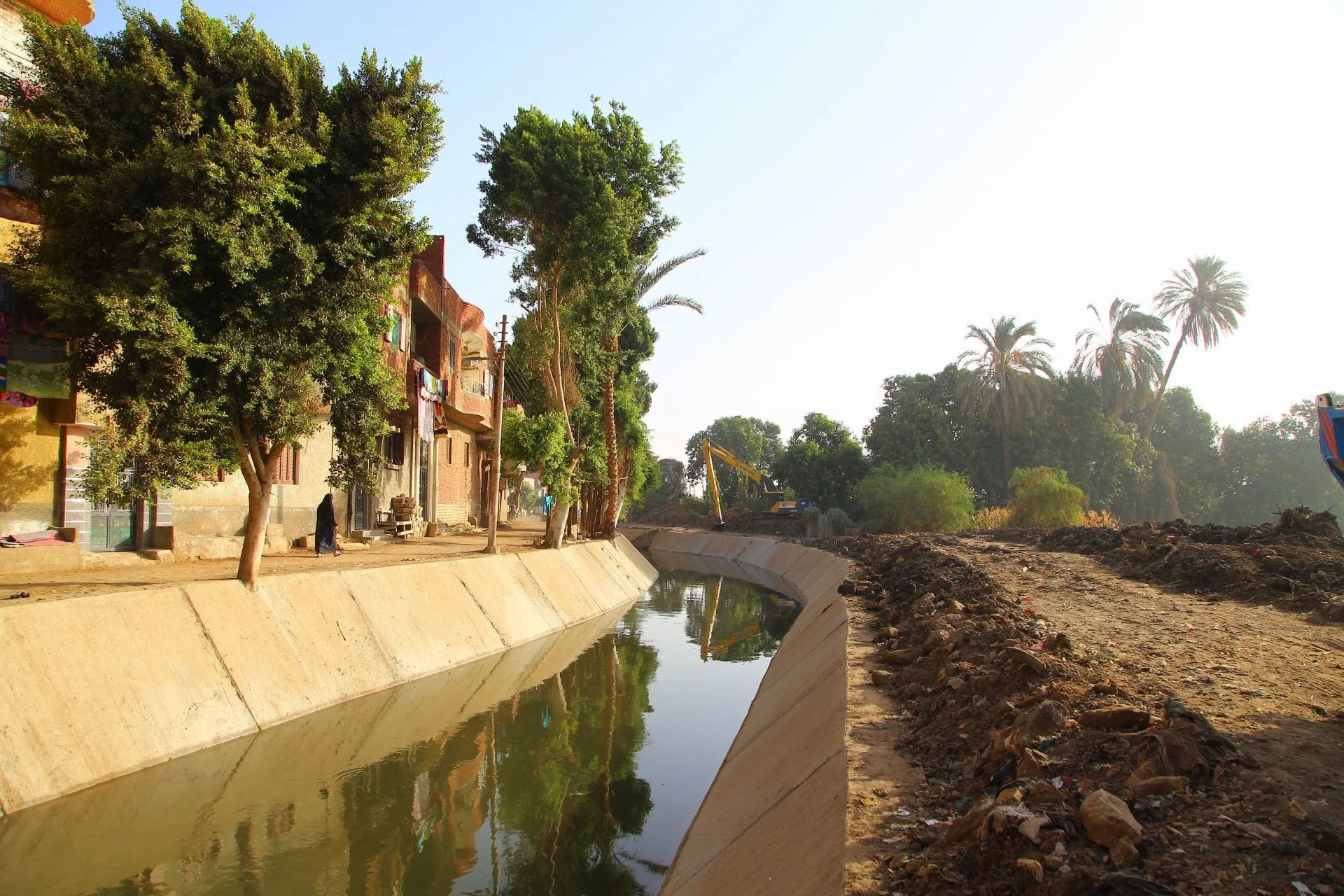
A large engineered irrigation canal crosses Egypt’s desert landscape, demonstrating the infrastructure required to transform arid territory into productive agricultural land. Projects such as the New Delta depend on canals, pipelines, pumping stations and treatment facilities working together across vast distances.
The Nile Question Egypt Cannot Escape
There is another dimension that makes the project especially sensitive.
Egypt's relationship with the Nile is not merely domestic.
For more than a decade, Cairo has been locked in a dispute with Ethiopia over the Grand Ethiopian Renaissance Dam, or GERD, constructed on the Blue Nile.
Egypt maintains that upstream development must not significantly harm downstream countries and has repeatedly sought a legally binding agreement governing GERD operations and data sharing.
Those tensions remain very much alive.
In August 2026, Egyptian Water Resources and Irrigation Minister Hani Sewilam publicly rejected the prospect of additional Ethiopian dams following reports that Addis Ababa could pursue further projects.
That geopolitical environment means every major Egyptian water project will inevitably be examined beyond Egypt's borders.
Critics may ask how Cairo can object to upstream Nile development while constructing enormous desert irrigation and urban projects of its own.
Egypt's position is that the issues are fundamentally different: its projects operate within water already reaching Egyptian territory, while upstream dams can potentially alter the timing and reliability of flows entering downstream states.
Regardless of which argument ultimately dominates diplomatic negotiations, the New Delta demonstrates why Cairo considers water security existential.
Egypt is planning decades of population, agricultural and economic expansion around assumptions about future water availability.
Source: Anadolu Agency
https://www.aa.com.tr/en/middle-east/egypt-says-it-won-t-allow-new-ethiopian-dams-on-nile-river/4018528
Building More Land Without Creating More Water
This is ultimately the paradox at the heart of Egypt's New Delta.
Engineering can create new farmland.
It can create canals.
It can construct pumping stations capable of moving millions of cubic meters across desert landscapes.
It can treat wastewater and reuse agricultural drainage.
It can even create what developers market as a new branch of the Nile.
What engineering cannot do is create unlimited freshwater.
Egypt's challenge is therefore not simply expanding its water network but extracting greater economic productivity from the water already available.
That explains why treated drainage water has become so important.
The country's Ministry of Water Resources and Irrigation increasingly describes reuse, digital water management, satellite monitoring, artificial intelligence and improved irrigation efficiency as components of a broader modernization of the national water system.
Egypt is effectively attempting to make its water infrastructure more circular and more closely monitored at the same time that it dramatically expands development into the desert.
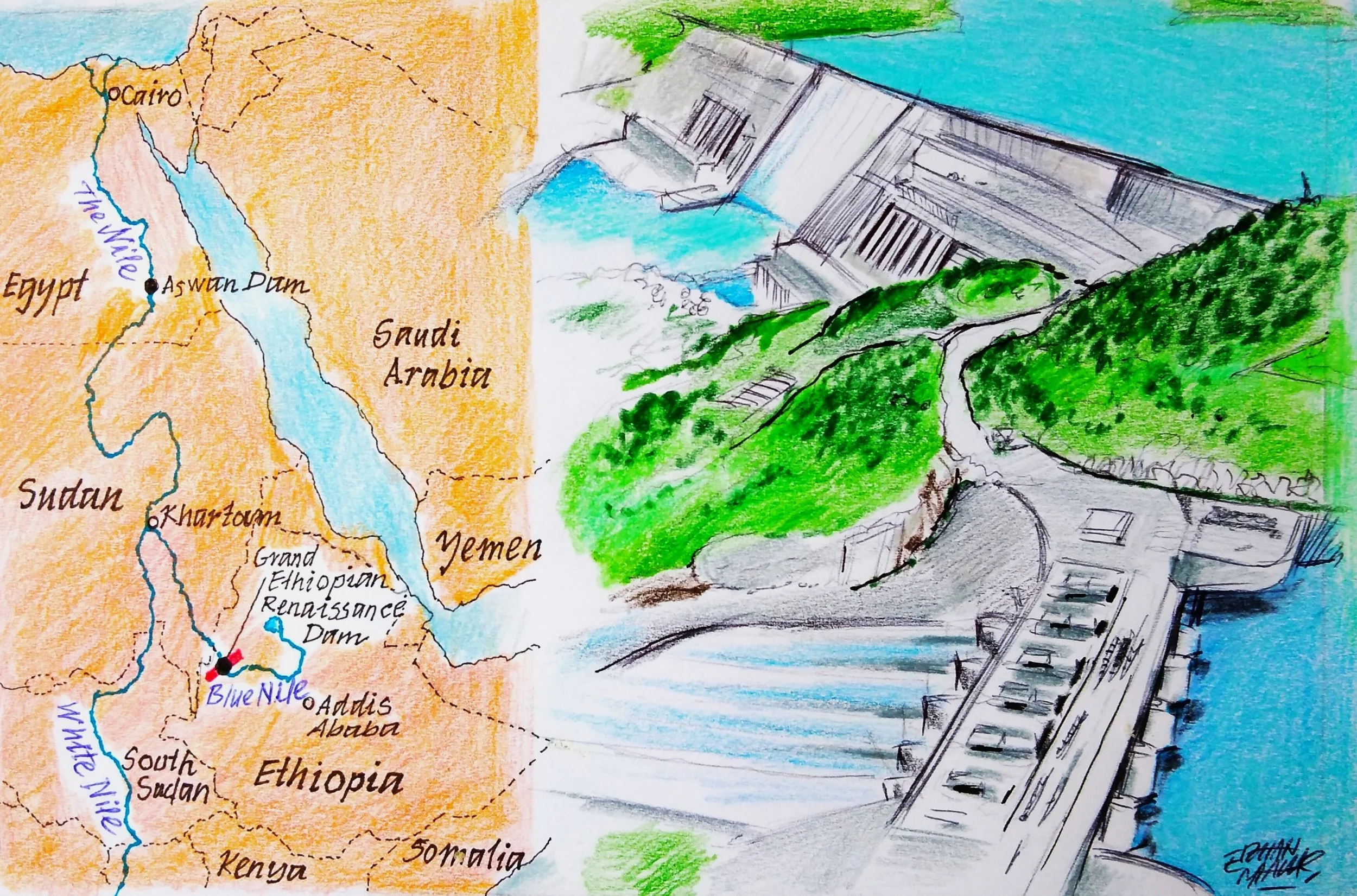
The Grand Ethiopian Renaissance Dam on the Blue Nile has become central to the debate surrounding water security in northeastern Africa. Egypt’s enormous New Delta water infrastructure is being developed against the backdrop of continuing regional concerns over the future availability and management of Nile water.
A Project That Could Reshape Egypt's Geography
The significance of the "New Nile" is ultimately larger than Jirian's waterfront apartments or even the New Delta's farms.
For centuries, Egyptian development has remained concentrated within a remarkably small portion of the country's total territory.
The desert has always been enormous.
The usable Egypt has been comparatively small.
Projects like the New Delta are attempts to change that equation.
Roads can open the desert to transportation. Electricity networks can support industry and housing. New cities can move population away from congested metropolitan areas.
But water remains the infrastructure that makes everything else possible.
If Egypt can successfully transport, treat, reuse and carefully manage water across the New Delta, it could establish a development corridor capable of supporting agriculture, industry and urban growth on land that previously had little economic value.
If the system proves too expensive, environmentally unsustainable or excessively demanding on limited water resources, however, it could become another warning about the limits of desert megaprojects.
That is what makes Egypt's new water corridor so consequential.
The country is not literally creating another Nile. It is attempting something arguably more complicated: constructing an engineered extension of the economic geography that the Nile created naturally over thousands of years.
The pumping stations, treatment plants and canals spreading west of Cairo represent a wager that twenty-first-century infrastructure can overcome one of Egypt's oldest geographical limitations.
And unlike many megaprojects, the consequences will not be measured only in buildings or kilometers of concrete.
They will be measured in water.
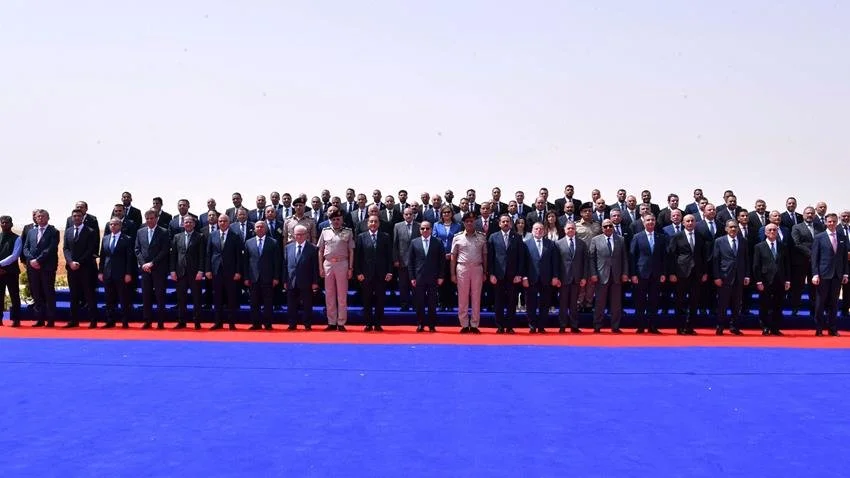
Egypt’s New Delta project represents one of the country's largest agricultural expansion programs, combining reclaimed desert land with new pumping stations, water-treatment infrastructure, roads and electrical networks. The development is intended to strengthen domestic food production while creating a major new economic corridor west of the traditional Nile Delta.
Additional Sources
Reuters — Egypt Plans Desert City Supplied With Diverted Nile Water
https://www.reuters.com/sustainability/land-use-biodiversity/egypt-plans-desert-city-supplied-with-diverted-nile-water-2025-06-01/
Presidency of the Arab Republic of Egypt — New Delta Project
https://www.presidency.eg/EN/%D9%82%D8%B3%D9%85-%D8%A7%D9%84%D8%A3%D8%AE%D8%A8%D8%A7%D8%B1/%D8%A3%D8%AE%D8%A8%D8%A7%D8%B1-%D8%B1%D8%A6%D8%A7%D8%B3%D9%8A%D8%A9/news1752026/
Egypt Ministry of Water Resources and Irrigation — 2026 Water Projects Update
https://www.mwri.gov.eg/?p=32310
Egypt Ministry of Water Resources and Irrigation — Dabaa Axis/New Delta Project
https://www.mwri.gov.eg/?page_id=32239
Egypt State Information Service — Jirian Development Announcement
https://mediadr.sis.gov.eg/handle/123456789/100282
Ahram Online — Explainer: What We Know About Egypt's New Delta
https://english.ahram.org.eg/NewsContentP/1/547404/Egypt/Explainer-What-we-know-about-Egypt%3Bs-New-Delta.aspx
