

Hagia Sophia: The 1,500-Year-Old Engineering Marvel That Has Survived Empires, Earthquakes and Reinvention
By BuildBrief News Desk
ISTANBUL — Few buildings on Earth have carried as much history beneath one roof as Hagia Sophia. Rising above Istanbul's historic peninsula with its enormous central dome, surrounding minarets and unmistakable silhouette, the structure has spent nearly 1,500 years at the intersection of architecture, engineering, religion and geopolitics.
It has been an imperial Byzantine cathedral, a Roman Catholic church during the Latin occupation of Constantinople, an Ottoman mosque, a museum and, once again, a functioning mosque. Emperors have worshipped beneath its dome. Armies have captured the city around it. Earthquakes have damaged it. Architects have reinforced it. Mosaics have been concealed, uncovered and conserved. Governments have repeatedly redefined its purpose.
Yet perhaps the most extraordinary aspect of Hagia Sophia is not simply what has happened inside the building. It is that the building is still standing.
Completed in the sixth century under Byzantine Emperor Justinian I, Hagia Sophia represented an extraordinary experiment in structural engineering. Its architects attempted to place an enormous dome over a vast, largely uninterrupted interior at a scale that pushed the limits of construction technology available at the time.
More than fourteen centuries later, that experiment remains one of the world's most influential buildings.
The UNESCO World Heritage Centre describes Hagia Sophia as one of the architectural masterpieces contributing to the Outstanding Universal Value of Istanbul's historic areas. UNESCO specifically points to its vast dome as evidence of the extraordinary architectural and decorative expertise achieved during the sixth century.

A defining exterior view of Hagia Sophia showing the enormous Byzantine central dome alongside the minarets added during its centuries as an Ottoman mosque. This works particularly well as the article's hero image because it immediately illustrates the architectural layers discussed throughout the story.
An Imperial Construction Project Unlike Anything Before It
The Hagia Sophia visible today was not the first church to occupy the site.
According to The Metropolitan Museum of Art, an earlier church was dedicated in 360 under Emperor Constantius, the son of Constantine. That building was destroyed during riots in 404. A replacement dedicated under Emperor Theodosius II in 415 survived for more than a century before it burned during the Nika revolt of 532.
The revolt devastated sections of Constantinople and presented Emperor Justinian I with an opportunity to rebuild on a dramatically greater scale.
Rather than reconstructing what had been lost, Justinian commissioned a monument that would demonstrate the wealth, technical capabilities and religious authority of the Byzantine Empire.
Construction of the present Hagia Sophia began in 532 and the building was inaugurated on December 27, 537. Its architects, Anthemius of Tralles and Isidore of Miletus, produced a design that combined elements of a longitudinal basilica with an enormous centralized domed space.
Source: https://www.metmuseum.org/de/essays/hagia-sophia-532-37
Completing such a massive structure in approximately five years becomes even more remarkable when viewed through the lens of modern construction.
There were no tower cranes, concrete pumps, hydraulic excavators, laser surveying instruments or computer-generated structural models. Materials had to be quarried, transported, shaped and positioned using human labor, animal power and relatively simple mechanical systems.
Yet the builders created an interior dominated by a monumental central dome that appears almost suspended above the space below.
It was architecture attempting to make engineering disappear.
The Engineering Behind the Dome
Hagia Sophia's defining engineering challenge was straightforward to describe but extremely difficult to solve: how could an enormous circular dome be supported above a largely square central space without filling the interior with massive structural walls?
The architects employed a sophisticated combination of arches, piers, semi-domes and pendentives.
Pendentives are curved triangular structural surfaces that make it possible to transition from a square supporting arrangement below to the circular base required by a dome above. Instead of supporting the dome continuously around its circumference with massive walls, its loads could be transferred through major arches into enormous supporting piers.
The resulting interior was dramatically more open than conventional masonry construction might suggest.
According to The Metropolitan Museum of Art, Hagia Sophia's central dome measures more than 101 feet, or approximately 31 meters, in diameter and rises approximately 160 feet, or 48.5 meters, above the floor.
Source: https://www.metmuseum.org/de/essays/hagia-sophia-532-37
Windows positioned around the base of the dome contributed to the extraordinary visual effect. Light entering beneath the dome reduced the visual weight of its supporting structure, creating the impression that the enormous masonry canopy was floating above the central space.
The effect impressed observers even in the sixth century.
But the engineering was aggressive, and the building soon demonstrated the consequences of operating near the limits of contemporary structural knowledge.
The original dome partially collapsed in 558 following structural problems and earthquake damage. It was subsequently reconstructed to a greater height, with the rebuilt version completed in 562.
Earthquakes and ground movement continued to affect Hagia Sophia throughout its history.
Rather than being a perfectly preserved sixth-century structure, the building visible today is the result of centuries of repairs, reconstruction, reinforcement and modification.
That distinction is critical to understanding why Hagia Sophia has survived.
Its longevity was not achieved because the original structure was indestructible. It survived because generations of builders repeatedly intervened when the structure showed signs of failure.
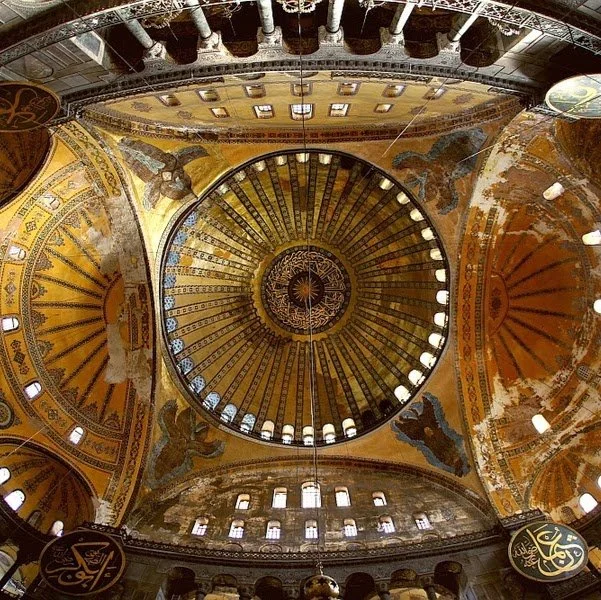
An upward-looking interior photograph showing the scale of Hagia Sophia's central dome and the structural transition between the dome and supporting architecture. This image helps readers visualize the engineering achievement behind the building's enormous sixth-century interior.
An Interior Designed to Overwhelm
Engineering alone does not explain Hagia Sophia's impact.
Its interior was conceived as an expression of imperial wealth and religious authority.
The Metropolitan Museum of Art reports that costly colored marble and ornamental stone covered significant portions of the interior. Columns and other architectural materials were also reused from ancient structures, while decorative elements and mosaics transformed the enormous structural shell into an extraordinarily elaborate religious environment.
Source: https://www.metmuseum.org/de/essays/hagia-sophia-532-37
Light became an architectural material in its own right.
Windows distributed around the central structure illuminated marble surfaces, mosaics and gold decoration. Instead of simply entering through openings in exterior walls, daylight was manipulated to emphasize the scale and apparent weightlessness of the dome.
The result was designed to create an emotional response.
Hagia Sophia was not merely a large building capable of accommodating worshippers. It was an imperial statement constructed at the political and religious center of the Byzantine world.
Constantinople was the capital of the Eastern Roman Empire, and architecture became a physical demonstration of the empire's technological capability, wealth and authority.
For centuries, Hagia Sophia's dome remained one of the defining architectural achievements of that civilization.
But the empire surrounding it would eventually disappear.
1453: From Cathedral to Mosque
One of the most consequential transformations in Hagia Sophia's history occurred in 1453.
Ottoman Sultan Mehmed II captured Constantinople, bringing the Byzantine Empire to an end and establishing Ottoman control over the city.
Hagia Sophia was converted into a mosque.
The transformation did not erase the Byzantine building. Instead, Ottoman rulers and architects gradually added another architectural layer to it.
Minarets were constructed around the complex. Christian imagery was covered in various areas, Islamic decorative elements were introduced and the building became one of the most significant mosques in the Ottoman capital.
The Metropolitan Museum of Art notes that Christian mosaic icons were covered during the Ottoman period, minarets were constructed around the building and exterior buttresses were added to provide additional structural support.
Source: https://www.metmuseum.org/de/essays/hagia-sophia-532-37
Those buttresses tell an important engineering story.
The Ottomans were not simply occupying an old Byzantine monument. They inherited responsibility for maintaining an enormous and structurally complicated masonry building in an earthquake-prone city.
Successive architects repaired and reinforced Hagia Sophia, ensuring that it continued functioning centuries after the civilization responsible for its original construction had disappeared.
The building also influenced the development of later Ottoman architecture.
UNESCO states that Hagia Sophia became a model for an entire family of churches and later mosques, contributing to its enormous influence on architecture in Europe and the Near East.
Source: https://whc.unesco.org/en/list/356/
Its architectural DNA can consequently be seen far beyond its walls.
Large centralized domes, semi-domes, monumental interior spaces and carefully orchestrated structural systems became defining characteristics of major Ottoman religious architecture.
Later Ottoman architects would develop increasingly sophisticated approaches of their own, but Hagia Sophia remained an unavoidable precedent.

The famous Deësis mosaic represents one of the most significant surviving examples of Byzantine artwork within Hagia Sophia. Its surviving tesserae provide a striking contrast to the later Islamic architectural and decorative elements found throughout the building.
From Mosque to Museum
Another dramatic transformation arrived during the 20th century following the collapse of the Ottoman Empire and establishment of the Republic of Turkey.
In 1934, the Turkish government secularized Hagia Sophia. The building subsequently opened as a museum in 1935.
The change created new opportunities for Byzantine artwork concealed during portions of the Ottoman period to be studied and restored.
The Metropolitan Museum of Art notes that original mosaics were restored following the building's conversion into a museum.
Source: https://www.metmuseum.org/de/essays/hagia-sophia-532-37
The museum period fundamentally altered Hagia Sophia's international identity.
Rather than functioning exclusively as a sacred space associated with a single religious tradition, it increasingly became presented as a monument representing multiple eras of Byzantine, Ottoman and global architectural history.
Visitors could stand beneath a dome constructed during Justinian's reign while simultaneously seeing architectural and decorative evidence of centuries of Islamic use.
That overlapping identity helped make Hagia Sophia one of the world's most recognizable historic structures.
In 1985, the Historic Areas of Istanbul were inscribed on the UNESCO World Heritage List.
UNESCO identifies Hagia Sophia as one of the exceptional monuments contributing to Istanbul's unique skyline and architectural heritage, alongside major Byzantine and Ottoman works.
Source: https://whc.unesco.org/en/list/356/
The Controversial 2020 Conversion
Hagia Sophia's official status changed once again in July 2020.
Following a Turkish court decision and presidential decree, the building was redesignated for use as a mosque, allowing Muslim worship to resume.
The decision was celebrated by supporters who viewed it as restoring Hagia Sophia's historical role as an Ottoman mosque. It also generated international criticism and concern regarding the management of the building's cultural heritage and its Byzantine artwork.
UNESCO expressed concern following the decision, emphasizing Hagia Sophia's position within a World Heritage property and the importance of preserving the attributes contributing to its Outstanding Universal Value.
Source: https://www.unesco.org/en/articles/unesco-statement-hagia-sophia-istanbul
The controversy demonstrated something that has followed Hagia Sophia throughout much of its existence: the building is almost impossible to separate from politics.
Who controls Hagia Sophia, how it is used and what its architecture represents have repeatedly been reinterpreted by successive governments, religions and civilizations.
Yet those debates can overshadow another reality.
Whatever its official designation, the physical structure remains an irreplaceable artifact of construction history.

A broad exterior photograph illustrating that Hagia Sophia is considerably more structurally complex than its famous dome suggests. The building's exterior contains centuries of additions, repairs and reinforcement that helped the monument survive earthquakes and structural movement.
A Building That Survived Because People Kept Repairing It
Modern megaprojects are frequently designed around expected service lives measured in decades.
Hagia Sophia operates on an entirely different timescale.
Nearly fifteen centuries separate its original construction from the present day.
That does not mean its original builders somehow created an indestructible structure. In fact, Hagia Sophia's history demonstrates almost the opposite.
The building has survived because generations recognized structural problems and intervened.
Domes were rebuilt. Masonry was repaired. Buttresses were added. Decorative surfaces were conserved. Earthquake damage was investigated. Structural behavior was studied.
UNESCO documentation includes numerous reports, missions and conservation records associated with Hagia Sophia and the wider Historic Areas of Istanbul.
Source: https://whc.unesco.org/en/list/356/documents/
The building therefore offers an important lesson for the modern construction industry.
Longevity is not simply something designed into a structure on opening day. It is created through maintenance.
Hagia Sophia's current form represents countless decisions made by engineers, architects, craftsmen, rulers, religious authorities and conservation specialists across more than a millennium.
Some interventions changed its appearance. Others prevented structural deterioration. Still others reflected the political priorities of whichever civilization controlled the building.
Together, they kept it standing.
Earthquakes: Hagia Sophia's Persistent Threat
One reason Hagia Sophia's survival is so extraordinary is Istanbul's seismic environment.
Earthquakes have repeatedly damaged the structure throughout its history, beginning within decades of its completion.
The original central dome experienced a major collapse in 558. Later earthquakes damaged portions of the building, requiring further repairs and reconstruction.
Modern conservation efforts have continued to examine these risks.
UNESCO maintains extensive documentation concerning the Historic Areas of Istanbul, including reports examining the conservation and structural condition of Hagia Sophia.
Source: https://whc.unesco.org/en/list/356/documents/
The engineering challenge is complicated by the building's age.
Modern engineers cannot simply approach Hagia Sophia as they would a conventional rehabilitation project. Every intervention must consider both structural performance and the preservation of irreplaceable historic materials.
Strengthening one portion of an ancient masonry structure can change how forces move through another.
Adding modern materials may create incompatibilities with ancient masonry.
Removing historic elements could destroy evidence of previous construction phases.
Preserving Hagia Sophia therefore requires balancing two goals that do not always align perfectly: protecting a functioning structure while conserving the physical evidence of its enormous history.

A close-up of the surviving Christ Pantocrator image demonstrates the extraordinary detail of Hagia Sophia's Byzantine mosaics. Individual tesserae combine to form subtle facial features, shading and coloration, revealing the craftsmanship preserved within the monument.
The Monument That Changed Architecture
Hagia Sophia's importance extends far beyond Istanbul.
Its combination of centralized space, monumental dome, supporting semi-domes, complex load transfer and dramatic interior lighting became a reference point for generations of architects.
UNESCO specifically identifies Hagia Sophia's influence as one of the reasons Istanbul's historic areas possess Outstanding Universal Value, noting that the building became a model for an entire family of churches and later mosques.
Source: https://whc.unesco.org/en/list/356/
Its influence is particularly significant because Hagia Sophia bridges architectural traditions that are often discussed separately.
It began as the supreme church of Byzantine Constantinople.
It later became one of the Ottoman world's most significant mosques.
Its structural vocabulary influenced buildings constructed under both Christian and Islamic patronage.
That makes Hagia Sophia difficult to place neatly inside a single architectural category.
It is Byzantine and Ottoman.
It represents Roman construction knowledge transformed through Byzantine experimentation.
It is simultaneously a religious building, an engineering landmark and a global heritage monument.
It is ancient by virtually any modern definition while remaining actively used.
Few buildings embody so many architectural layers simultaneously.
Hagia Sophia's Greatest Achievement May Be Survival
Standing inside Hagia Sophia today means occupying a space that would remain structurally recognizable to people who entered it more than a thousand years ago.
That continuity is extraordinary.
Cities surrounding historic monuments constantly change. Governments fall. Religions expand and contract. Technologies become obsolete. Earthquakes strike. Wars reshape borders. Buildings once assumed to be permanent disappear.
Hagia Sophia endured.
Its walls reveal that endurance not through perfect preservation, but through modification.
The minarets surrounding its Byzantine dome immediately communicate that this is not a monument frozen at one moment in history. Buttresses demonstrate centuries of structural intervention. Christian mosaics and monumental Islamic calligraphy occupy the same enormous architectural environment, creating a physical record of civilizations that inherited the building from one another.
For the construction industry, Hagia Sophia is far more than a historic landmark.
It is a case study in structural ambition, engineering failure, reconstruction, adaptive reuse, seismic resilience, conservation and long-term maintenance on a scale almost impossible to replicate.
The architects of the sixth century could not have known every role their building would eventually serve.
They could not have predicted the Ottoman conquest, the creation of modern Turkey, UNESCO World Heritage designation, international tourism or contemporary structural conservation.
What they accomplished was something perhaps even more remarkable.
They created a structure powerful enough that almost every civilization inheriting it decided that it was worth preserving.
Nearly 1,500 years after construction began, Hagia Sophia continues to dominate Istanbul's historic skyline.
Its purpose has changed.
Its appearance has changed.
The city surrounding it has changed beyond recognition.
But the great dome remains.
And perhaps that is Hagia Sophia's most remarkable engineering achievement of all.

A wider view places Hagia Sophia within Istanbul rather than treating the building as an isolated monument. Its enormous dome and minarets remain defining elements of the historic peninsula's skyline nearly 1,500 years after the original structure was completed.
Sources
UNESCO World Heritage Centre — Historic Areas of Istanbul
https://whc.unesco.org/en/list/356/
The Metropolitan Museum of Art — Hagia Sophia, 532–37
https://www.metmuseum.org/de/essays/hagia-sophia-532-37
The Metropolitan Museum of Art — Hagia Sophia
https://www.metmuseum.org/exhibitions/listings/2012/byzantium-and-islam/blog/where-in-the-world/posts/hagia-sophia
UNESCO — Statement on Hagia Sophia, Istanbul
https://www.unesco.org/en/articles/unesco-statement-hagia-sophia-istanbul
UNESCO World Heritage Centre — Historic Areas of Istanbul Documents and Conservation Reports
https://whc.unesco.org/en/list/356/documents/
UNESCO World Heritage Centre — Hagia Sophia Search and Conservation Archive
https://whc.unesco.org/en/search/?criteria=hagia+sophia
