

Akron Airdock: The Giant Ohio Hangar Where America’s Airship Industry Is Taking Flight Again
By BuildBrief News Desk
AKRON, Ohio — On the industrial southeast side of Akron stands a building so large that its scale can be difficult to understand from the road. Stretching more than 1,100 feet from end to end, the historic Akron Airdock, also known as the Goodyear Airdock, is one of the most remarkable pieces of aviation infrastructure ever constructed in the United States.
Nearly a century after it was built to manufacture enormous U.S. Navy airships, the Akron landmark is again connected to the development of lighter-than-air aircraft. The revival is bringing new relevance to a structure that once placed Northeast Ohio at the center of an ambitious chapter in American aviation.
According to the National Park Service, the Goodyear Airdock was constructed in 1929 by the Goodyear Zeppelin Corporation using plans created by Cleveland's Wilbur Watson Engineering Company. Construction began on April 20 and was completed by November 25 of the same year, at a reported cost of approximately $2.2 million.
https://www.nps.gov/articles/goodyear-airdock.htm
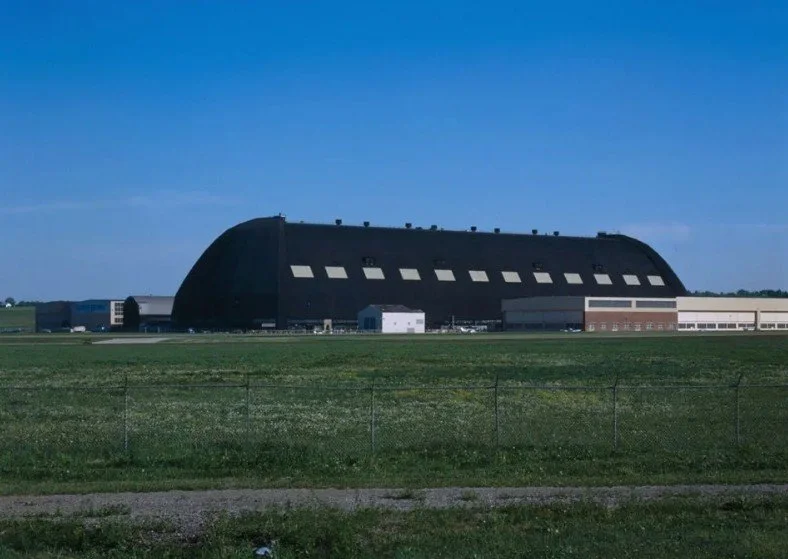
The enormous curved profile of the Akron Airdock immediately communicates why this building became an engineering landmark. Built for the construction of giant rigid airships, the hangar stretches more than 1,100 feet and remains one of the most recognizable pieces of aviation infrastructure in Ohio.
An Engineering Landmark Built for Giants
The numbers behind the Akron Airdock remain extraordinary even by modern industrial construction standards. The structure measures approximately 1,175 feet long, 325 feet wide and 211 feet high, creating a cavernous interior specifically designed to accommodate enormous rigid airships.
The American Society of Civil Engineers reports that the building contains more than 364,000 square feet of obstruction-free floor space and has a volume of roughly 55 million cubic feet. When completed, it was considered the world's largest building in terms of uninterrupted interior space.
https://www.asce.org/about-civil-engineering/history-and-heritage/historic-landmarks/goodyear-airdock
Its distinctive semi-parabolic shell was more than an architectural statement. Engineers had to understand how strong winds would interact with a building of unprecedented dimensions. Wind-tunnel testing was used to study pressure and suction forces on a scale model before the final design was completed.
Even the doors became major engineering projects. Each end of the Airdock incorporates enormous semi-spherical doors. According to the National Park Service, each weighs about 600 tons and rides on 40 wheels positioned along curved railroad tracks.
The result was essentially an enormous machine disguised as a building — one engineered around the movement, construction and maintenance of aircraft hundreds of feet long.
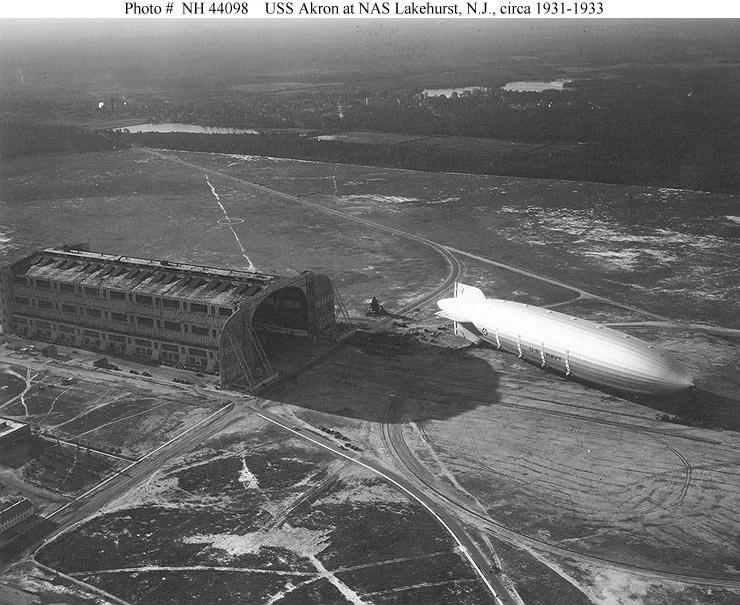
Few photographs illustrate the purpose and extraordinary scale of the Akron Airdock better than this historic view of the USS Akron emerging through its enormous doors. The 785-foot rigid airship was built inside the hangar and became one of the most ambitious aircraft developed for the U.S. Navy during the interwar period.
Birthplace of the USS Akron and USS Macon
The building's defining purpose was the construction of rigid airships for the U.S. Navy.
Inside the Akron Airdock, workers assembled the USS Akron (ZRS-4) and its sister ship, the USS Macon (ZRS-5). The Akron was launched in 1931, followed by the Macon during the early 1930s. Both represented an era when military planners were experimenting with enormous lighter-than-air aircraft capable of operating over vast distances.
The Akron and Macon were approximately 785 feet long, yet the Airdock had deliberately been designed with room for even larger aircraft.
That ambition reflected Akron's growing importance in aviation as well as its established industrial base. Goodyear had been founded in the city in 1898, and Akron's concentration of rubber manufacturers, skilled workers and transportation infrastructure eventually helped earn it the title “Rubber Capital of the World.”
https://corporate.goodyear.com/us/en/company/history.html
The Airdock expanded that industrial identity beyond tires and rubber products, establishing Akron as an important center for lighter-than-air engineering and manufacturing.
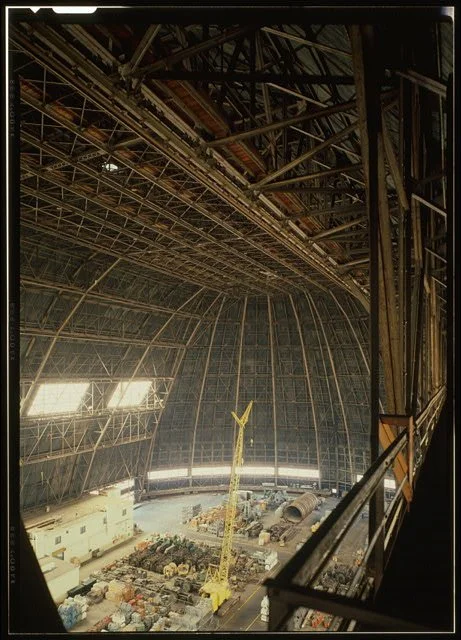
Looking through the interior reveals the engineering achievement hidden beneath the Airdock's dark exterior. Its immense uninterrupted floor and towering steel framework created enough open space to assemble airships hundreds of feet long, allowing workers to construct some of the largest aircraft of their era entirely indoors.
From Airships to Wartime Manufacturing
The usefulness of such a vast enclosed manufacturing space did not disappear as rigid-airship programs declined.
During World War II, the Airdock was adapted for wartime industrial production at a moment when large enclosed manufacturing facilities were urgently needed. Over subsequent decades, the site supported numerous aerospace and industrial operations, including photographic work, equipment storage, aircraft-related manufacturing and testing.
The American Society of Civil Engineers identifies the U.S. Navy's ZPG-3W, completed in 1960, as the last airship constructed inside the Airdock.
https://www.asce.org/about-civil-engineering/history-and-heritage/historic-landmarks/goodyear-airdock
Ownership and operations subsequently changed hands. Goodyear Aerospace assets, including the Airdock, were purchased by Loral Corporation in 1987, while Lockheed Martin later became involved with the property following its acquisition of portions of Loral.
The site also faced a significant environmental challenge after polychlorinated biphenyls, or PCBs, were discovered in original roofing and siding materials. Regulatory documents show that extensive assessment, remediation and monitoring programs followed.
https://www.lockheedmartin.com/content/dam/lockheed-martin/eo/documents/remediation/akron/NFA-Submission-5Mar2009.pdf
That environmental work became an important part of preparing the historic industrial property for another generation of aerospace activity.
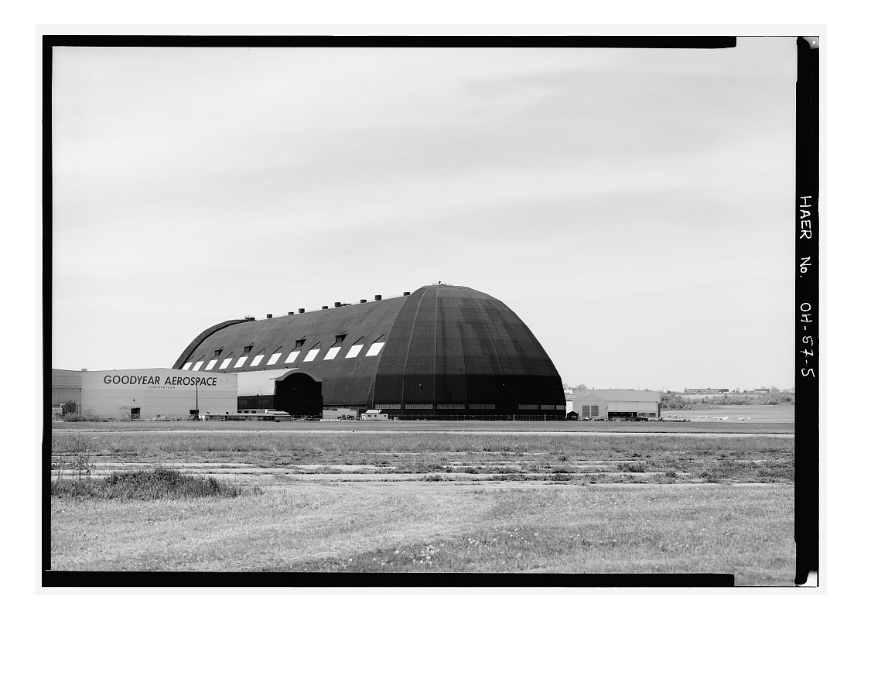
Opening the end of the Akron Airdock was an engineering operation in its own right. The gigantic curved doors allowed enormous airships to enter and leave the hangar while preserving the uninterrupted shell that made the building so unusual. The scale of the vehicles and people near the entrance provides a striking reference for just how large the structure really is.
LTA Research Brings Airship Development Back to Akron
The most significant chapter in the Airdock's recent history began with LTA Research, a company developing a new generation of rigid airships.
LTA says it became the official owner of the Akron Airdock in 2022, assuming stewardship of the historic structure. The company's operations are now connecting Akron's early airship manufacturing history with modern aerospace engineering.
https://ltaresearch.com/our-story
The Development Finance Authority of Summit County had previously owned the Airdock, and government financial documents confirm that LTA acquired the property in 2022. Summit County reported that LTA has since expanded its Akron operations, with the historic Airdock serving as a production and research location for next-generation lighter-than-air aircraft.
In March 2025, the Federal Reserve Bank of Cleveland reported that nearly one-third of LTA's approximately 300 employees were working in Ohio. The Akron team was supporting the company's Pathfinder 1 program while developing technologies intended for future airships expected to be constructed at the Airdock.
https://www.clevelandfed.org/collections/around-the-district/2025/atd-20250326-akron
Among the technologies being developed are advanced manufacturing methods for airship components, including laser welding of titanium parts and precision inspection systems.
LTA's Pathfinder 1, a 406-foot rigid airship, has meanwhile been undergoing flight testing in California. The company reported in June 2026 that Pathfinder 1 was the only rigid airship flying at that time, illustrating just how unusual the technology remains within the modern aviation industry.
https://ltaresearch.com/updates
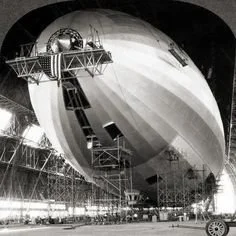
This photograph puts the Airdock's extraordinary dimensions into perspective. The partially assembled airship appears enormous beside the workers below it, yet the aircraft still fits comfortably beneath the hangar's sprawling structural framework. Scenes like this defined Akron's brief but important position at the center of America's rigid-airship industry.
Old Infrastructure, New Aviation Ambitions
The renewed activity surrounding the Akron Airdock is notable because this is not simply an exercise in historic preservation. The building is again being used within the same technological field that justified its construction nearly 100 years ago.
Modern airship developers are examining potential applications ranging from cargo transportation and passenger travel to humanitarian logistics. Lighter-than-air aircraft could offer advantages in situations where conventional roads, ports or runways are limited, although turning those possibilities into commercially viable transportation systems will require substantial engineering, certification and operational development.
For Akron, however, the connection is difficult to ignore.
A building designed in 1929 for an emerging generation of enormous aircraft has survived long enough to become part of another attempt to reinvent lighter-than-air transportation. Its steel arches, immense doors and obstruction-free interior were engineering solutions created for machines that largely disappeared from mainstream aviation decades ago.
Now, engineers are once again working inside the Akron Airdock on the future of airships.
Nearly a century after workers assembled the USS Akron beneath its towering roof, one of America's most extraordinary industrial buildings may be returning to the job it was designed to do.

Nearly a century after the Airdock was built for giant Navy dirigibles, this image captures the remarkable return of rigid-airship technology to Akron. A modern lighter-than-air aircraft sits beneath the historic hangar structure, visually connecting the city's pioneering aviation past with a new generation of airship engineering and manufacturing.
Sources
National Park Service — Goodyear Airdock
https://www.nps.gov/articles/goodyear-airdock.htm
American Society of Civil Engineers — Goodyear Airdock Historic Landmark
https://www.asce.org/about-civil-engineering/history-and-heritage/historic-landmarks/goodyear-airdock
Goodyear — Company History
https://corporate.goodyear.com/us/en/company/history.html
LTA Research — Our Story
https://ltaresearch.com/our-story
LTA Research — Updates
https://ltaresearch.com/updates
Federal Reserve Bank of Cleveland — Airships May Soon Be Built in Akron Again
https://www.clevelandfed.org/collections/around-the-district/2025/atd-20250326-akron
Lockheed Martin — Akron Airdock Environmental Documentation
https://www.lockheedmartin.com/content/dam/lockheed-martin/eo/documents/remediation/akron/NFA-Submission-5Mar2009.pdf
