A New $2.8 Billion Particle Collider Is Taking Shape in New York
One of America's most ambitious scientific construction projects is beginning to take physical shape on Long Island, New York.
The Electron-Ion Collider (EIC) is a next-generation particle accelerator being developed at Brookhaven National Laboratory in Upton, New York. The massive U.S. Department of Energy project will transform infrastructure from Brookhaven's former Relativistic Heavy Ion Collider, better known as RHIC, into a new scientific facility designed to investigate some of the most fundamental questions about matter.
And this isn't simply another laboratory building.
The EIC will require new accelerator systems, superconducting magnets, electrical infrastructure, specialized buildings, an enormous particle detector, and some of the most precise scientific equipment ever constructed.
Brookhaven describes the EIC as a high-energy, high-luminosity polarized collider designed to investigate the origin of mass and the structure of atomic nuclei. The project is being delivered with major participation from Thomas Jefferson National Accelerator Facility and an international community of scientists and engineers.
Current Brookhaven project information places the expected cost at approximately $2.8 billion, while leveraging roughly $2 billion worth of existing RHIC infrastructure.
For the construction industry, the Electron-Ion Collider is particularly interesting because engineers aren't starting with an empty site.
They're transforming one of America's most important existing scientific facilities into an entirely new machine.
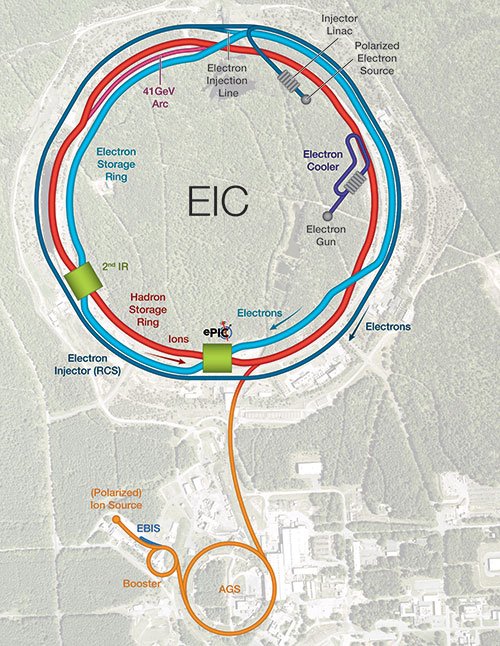
A schematic of the planned Electron-Ion Collider over the existing RHIC complex at Brookhaven National Laboratory. Credit: Brookhaven National Laboratory/Tiffany Bowman.
What Is the Electron-Ion Collider?
The Electron-Ion Collider, or EIC, is a particle accelerator being constructed at Brookhaven National Laboratory in New York to collide high-energy electrons with protons and atomic nuclei.
Those collisions will allow scientists to investigate quarks and gluons—the fundamental particles and interactions responsible for much of the structure of visible matter.
In simplified terms, scientists want to look deeper inside protons and neutrons.
Protons and neutrons make up atomic nuclei, but they aren't solid objects. Inside them exists an incredibly dynamic environment involving quarks and gluons governed by the strong nuclear force.
The EIC is being designed to give researchers extraordinarily detailed information about that internal structure.
Scientists hope experiments conducted at the collider will help answer questions involving where the mass and spin of protons come from and how gluons help bind matter together.
Brookhaven says the machine will produce high-energy collisions between polarized electrons and polarized protons or ions, allowing researchers to construct detailed three-dimensional views of the internal structure of matter.
But producing those measurements requires an extraordinary piece of engineering.
Where Is the Electron-Ion Collider Being Built?
The Electron-Ion Collider is being built at Brookhaven National Laboratory in Upton, New York, on Long Island.
The U.S. Department of Energy selected Brookhaven as the location for the EIC in January 2020.
One of the biggest advantages of the Brookhaven site is already underground.
Brookhaven operated the Relativistic Heavy Ion Collider (RHIC) for 25 years. RHIC conducted its final run in early 2026, opening the door for the laboratory to begin transforming portions of the existing accelerator complex into the EIC.
Rather than abandoning billions of dollars of highly specialized infrastructure, the EIC project is designed to reuse significant portions of it.
That includes the existing collider tunnel, ion accelerator systems, utilities, and one of RHIC's superconducting ion storage rings.
The result is an unusual combination of demolition, renovation, infrastructure construction, precision installation, and highly specialized scientific engineering.
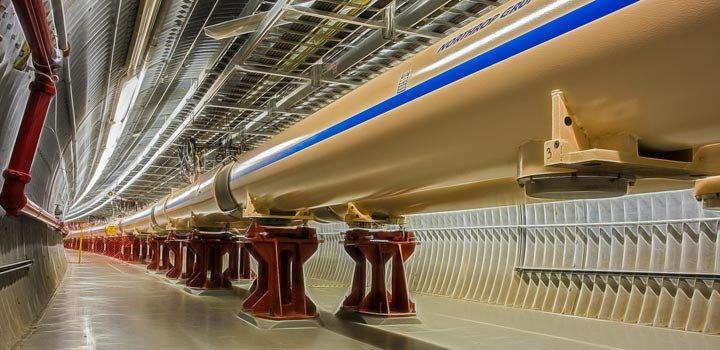
Inside Brookhaven National Laboratory's RHIC accelerator tunnel. Major portions of RHIC infrastructure will be reused for the new Electron-Ion Collider. Credit: Steve Zimic/Brookhaven National Laboratory.
Transforming RHIC Into the Electron-Ion Collider
The transition from RHIC to EIC officially became visible in April 2026, when Brookhaven announced that crews had begun removing and repurposing equipment from the former collider.
RHIC contained two rings of superconducting ion storage magnets running alongside each other through much of its underground tunnel.
For the Electron-Ion Collider, one of those rings will remain part of the ion accelerator system.
The other will make way for something entirely new:
an electron storage ring.
That distinction is fundamental to how the EIC will operate.
RHIC primarily collided heavy ions and polarized protons with one another. The EIC will instead collide electrons with protons and atomic nuclei.
That requires an entirely new collection of accelerator components capable of producing, accelerating, controlling, storing, and steering an electron beam.
From a construction perspective, it's similar to performing a massive industrial retrofit—except the machinery being installed must manipulate subatomic particles traveling at nearly the speed of light.
Construction of the Electron-Ion Collider Begins to Accelerate
The EIC has progressed through several Department of Energy project milestones.
The DOE officially established the mission need for the collider in 2019, followed by selection of Brookhaven as the site in 2020.
Conceptual design approval followed in 2021.
In 2024, the project received approval for its first major package of long-lead procurements.
Those purchases are critical because many EIC components aren't products that can simply be ordered from a warehouse.
They include highly specialized superconducting materials, accelerator components, detector technology, and other equipment that can require significant manufacturing lead times.
The project reached another important point in February 2026, when the Department of Energy approved Critical Decision 3B (CD-3B).
That authorization allows another phase of federally funded long-lead procurement to move forward as the EIC transitions toward full construction.
The earlier procurement phase resulted in more than $24 million in contracts with U.S. companies, along with approximately $8.3 million in specialized equipment purchased from overseas suppliers.
The goal is straightforward: make sure critical components arrive when construction teams need them instead of allowing long manufacturing schedules to delay the project.
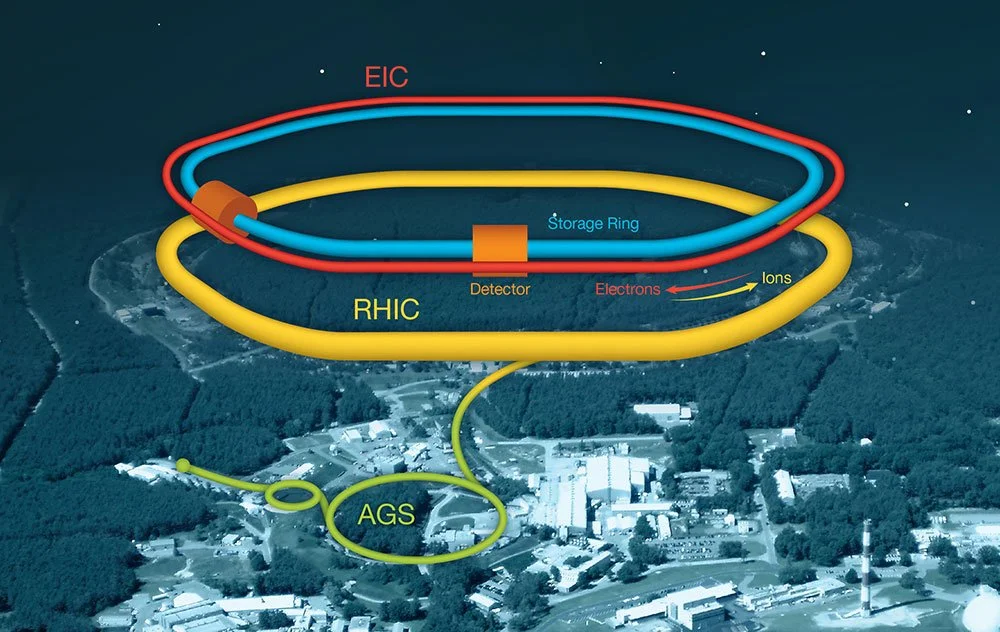
The Electron-Ion Collider will reuse critical infrastructure from Brookhaven's Relativistic Heavy Ion Collider while adding new electron accelerator systems. Credit: Tiffany Bowman/Brookhaven National Laboratory.
Conventional Construction Is a Major Part of the EIC Project
Not everything about the Electron-Ion Collider involves superconducting magnets and particle physics.
Before many of those systems can operate, conventional construction crews have significant work to complete.
New York State committed $100 million toward infrastructure supporting the EIC.
That funding is helping support new buildings and conventional infrastructure required for the collider.
In 2026, Brookhaven reported that early construction would involve approximately six acres spread across five construction sites.
Initial work includes:
Clearing trees and vegetation
Removing topsoil
Excavation
Preparing building pads
Installing erosion-control measures
Temporary fencing
Electrical infrastructure
Construction supporting new power-supply buildings
Electrical capacity is particularly important.
Particle accelerators require enormous amounts of sophisticated electrical infrastructure to power magnets, radio-frequency systems, cooling equipment, electronics, detectors, and other machinery.
In 2026, four major electrical unit substations arrived at Brookhaven to support new EIC power-supply buildings.
It's an important reminder that even one of the world's most sophisticated scientific instruments still depends on familiar construction fundamentals: excavation, concrete, structural systems, utilities, electrical distribution, mechanical systems, and careful sequencing.
Why Reusing RHIC Infrastructure Matters
One of the most impressive aspects of the EIC project may be what isn't being constructed from scratch.
Brookhaven estimates that the project is leveraging approximately $2 billion in existing RHIC infrastructure.
That includes accelerator tunnels and systems that would be extraordinarily expensive and time-consuming to reproduce today.
Reusing RHIC also allows Brookhaven to preserve decades of institutional knowledge.
Accelerator facilities require highly specialized engineers, technicians, scientists, electricians, operators, and tradespeople who understand equipment that exists almost nowhere else.
Maintaining that workforce during the transition is therefore a major project consideration.
For large construction projects, the EIC offers an interesting example of adaptive reuse at an enormous technical scale.
Adaptive reuse usually brings to mind converting an old warehouse into apartments or turning an industrial building into offices.
Brookhaven is effectively performing adaptive reuse on a particle collider.
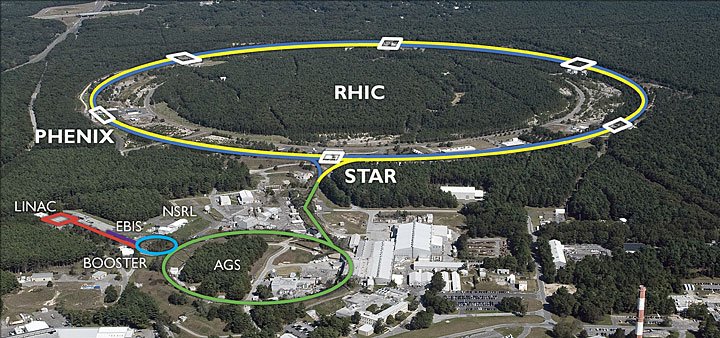
An aerial view of the RHIC accelerator complex at Brookhaven National Laboratory on Long Island, New York, where infrastructure is being transformed for the future EIC.
The ePIC Detector: Where the Collisions Become Data
Accelerating particles is only half the challenge.
Scientists also need a way to analyze what happens when those particles collide.
That's where ePIC comes in.
The Electron-Proton/Ion Collider, or ePIC, Collaboration is developing the first major detector for the EIC.
Brookhaven describes ePIC as an international collaboration involving hundreds of scientists and engineers.
The detector will surround an EIC collision point with layers of sophisticated sensors designed to identify and measure particles produced during electron-ion collisions.
Imagine building an enormous three-dimensional scientific camera around a collision happening at the subatomic scale.
Except this "camera" must capture events occurring incredibly quickly, distinguish different particles, measure their energy and trajectories, and generate enormous amounts of scientific data.
Developing ePIC requires expertise spanning mechanical engineering, electrical engineering, electronics, computing, detector physics, cryogenics, manufacturing, and precision assembly.
The detector therefore represents a major engineering project within the larger EIC construction program.
How Powerful Will the Electron-Ion Collider Be?
Raw energy isn't the only important measurement for a particle collider.
The EIC is also being designed around high luminosity.
In particle physics, luminosity essentially describes how frequently useful particle collisions can occur.
More collisions mean more experimental data.
Brookhaven's design calls for luminosity reaching approximately 10³⁴ collisions per square centimeter per second, giving scientists enormous quantities of information to analyze.
The EIC will also have another important capability: polarization.
Researchers will be able to precisely control the spin orientation of particles in the colliding beams.
Combining polarization, high luminosity, and multiple ion species gives scientists a powerful new tool for studying the internal structure of matter.
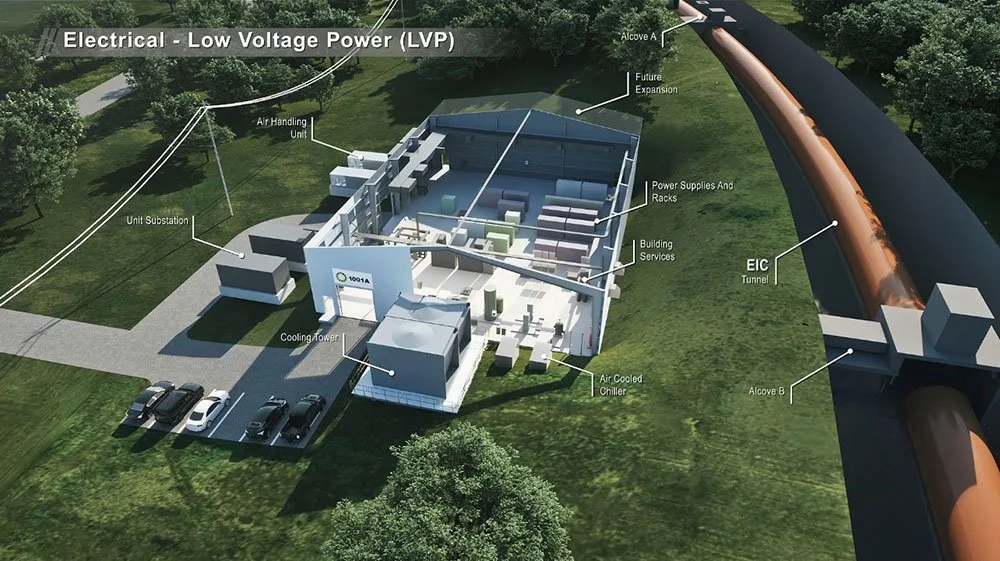
New electrical infrastructure arrives at Brookhaven National Laboratory to support construction and operation of the Electron-Ion Collider.
How Much Will the Electron-Ion Collider Cost?
Current Brookhaven project information estimates the Electron-Ion Collider will cost approximately $2.8 billion, while making use of roughly $2 billion in existing RHIC infrastructure.
Earlier DOE planning documents described the total project cost range as approximately $1.7 billion to $2.8 billion, with the final performance baseline determining the project's formal cost and schedule.
The federal government is providing the majority of EIC funding through the U.S. Department of Energy's Office of Science.
New York State is contributing another $100 million toward buildings and conventional infrastructure.
By 2026, Congress had already provided more than $500 million toward the EIC project, according to Brookhaven project information.
That makes the EIC one of America's most significant current investments in scientific research infrastructure.
When Will the Electron-Ion Collider Be Completed?
The current Brookhaven project timeline points toward electron-hadron collisions in 2035.
Before that can happen, the project must pass additional DOE milestones, complete construction, install accelerator systems, build and commission the ePIC detector, test the new electron and ion systems, and bring the entire facility online.
Brookhaven's 2026 project update identifies the end of 2026 as the target for approval of the project's performance baseline and the start of substantial construction.
As with any project of this complexity, schedules can evolve.
The EIC involves specialized equipment manufactured by a relatively small number of qualified suppliers, international scientific contributions, highly complex engineering, and precise integration between new and existing infrastructure.
This isn't simply a building that can be declared finished when the walls and roof are complete.
Every accelerator component must ultimately operate together as one machine.
Why the Electron-Ion Collider Matters Beyond Physics
The EIC's primary mission is fundamental nuclear science, but projects of this scale can push technology forward in unexpected ways.
Particle accelerators have historically contributed to technologies used outside fundamental physics.
Research and development connected to the EIC could advance areas including superconducting magnets, accelerator technology, particle detectors, high-performance computing, artificial intelligence, advanced electronics, and precision manufacturing.
Brookhaven has also highlighted potential connections to technologies used in medicine, semiconductor manufacturing, battery research, radiation-resistant materials, and other scientific applications.
Then there is the workforce impact.
Designing and constructing the Electron-Ion Collider requires highly skilled scientists, engineers, technicians, construction workers, manufacturers, and specialized suppliers.
It also creates an opportunity to train a new generation of people who will eventually design, operate, and maintain America's future scientific infrastructure.
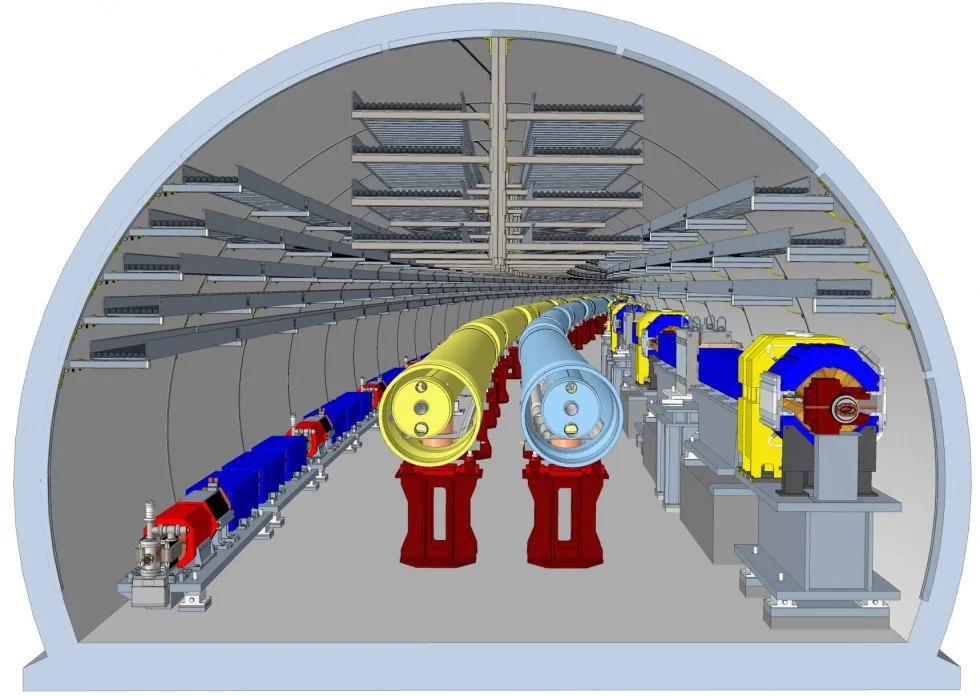
The ePIC detector will sit along the Electron-Ion Collider beamline and record particles produced when high-energy electrons collide with protons and atomic nuclei.
A Construction Project Measured in Nanometers and Miles
Most major construction projects are impressive because of their physical scale.
The Electron-Ion Collider is impressive because it combines enormous scale with almost unimaginable precision.
Construction crews and engineers will work across acres of Brookhaven's campus and around a collider complex stretching for miles.
Yet the ultimate purpose of that infrastructure is to control particles far smaller than anything visible to the human eye.
Magnets must precisely steer beams.
Vacuum systems must maintain extreme conditions.
Detector components must align accurately.
Electrical and cooling infrastructure must support equipment operating continuously.
Thousands of individual components ultimately have to behave like parts of one enormous machine.
Few construction projects illustrate the connection between traditional construction and advanced engineering quite as clearly.
The Electron-Ion Collider Could Define the Next Era of U.S. Nuclear Physics
For 25 years, RHIC helped scientists investigate matter under extreme conditions.
Its final run ended in 2026.
But its infrastructure isn't being abandoned.
It's becoming the foundation for something new.
Over the coming years, sections of RHIC will be dismantled, existing systems will be repurposed, new buildings will rise, electrical infrastructure will expand, accelerator components will arrive from manufacturers, superconducting systems will be installed, and the massive ePIC detector will take shape.
Eventually, electrons will begin circulating through a storage ring that doesn't exist today.
Those electrons will collide with protons and atomic nuclei, generating data that scientists hope will answer questions humanity has been asking for decades about the fundamental structure of matter.
The Electron-Ion Collider is therefore more than a $2.8 billion science project.
It's a massive construction, engineering, manufacturing, and technology undertaking that will transform an existing particle accelerator into one of the world's most advanced scientific instruments.
And for anyone interested in the future of construction, the EIC demonstrates something remarkable:
Sometimes the most ambitious projects aren't skyscrapers, bridges, highways, or stadiums.
Sometimes we're building machines designed to see inside matter itself.
The Electron-Ion Collider isn't just being built to explore the future of physics. Its construction is an engineering achievement worth watching in its own right.
