Australia’s Proposed East Coast High-Speed Rail Network: A New Era for Australian Transport?
For decades, high-speed rail in Australia has occupied an unusual place somewhere between serious infrastructure policy and national daydream. The idea is easy to understand: connect the major population centuries of Australia’s east coast with fast, frequent trains, giving travelers an alternative to driving or flying. Yet despite numerous studies and proposals, no Australian high-speed railway has ever reached construction.
That may finally be changing.
The Australian Government is progressing plans for an east coast high-speed rail network that would eventually connect Brisbane, Sydney, Canberra and Melbourne, while also serving major regional communities along the route. Rather than attempting to construct the entire network at once, the government is beginning with a Newcastle-to-Sydney line and intends to develop the broader network in stages. citeturn0search0turn0search7
The proposal is enormously ambitious. If completed, it could reshape how Australians travel, influence where people live and work, encourage regional development and provide serious competition to some of the country's busiest domestic airline routes.
But it would also require tens of billions of dollars, decades of construction and sustained political commitment.
So what exactly is being proposed, and could Australia finally be ready for high-speed rail?
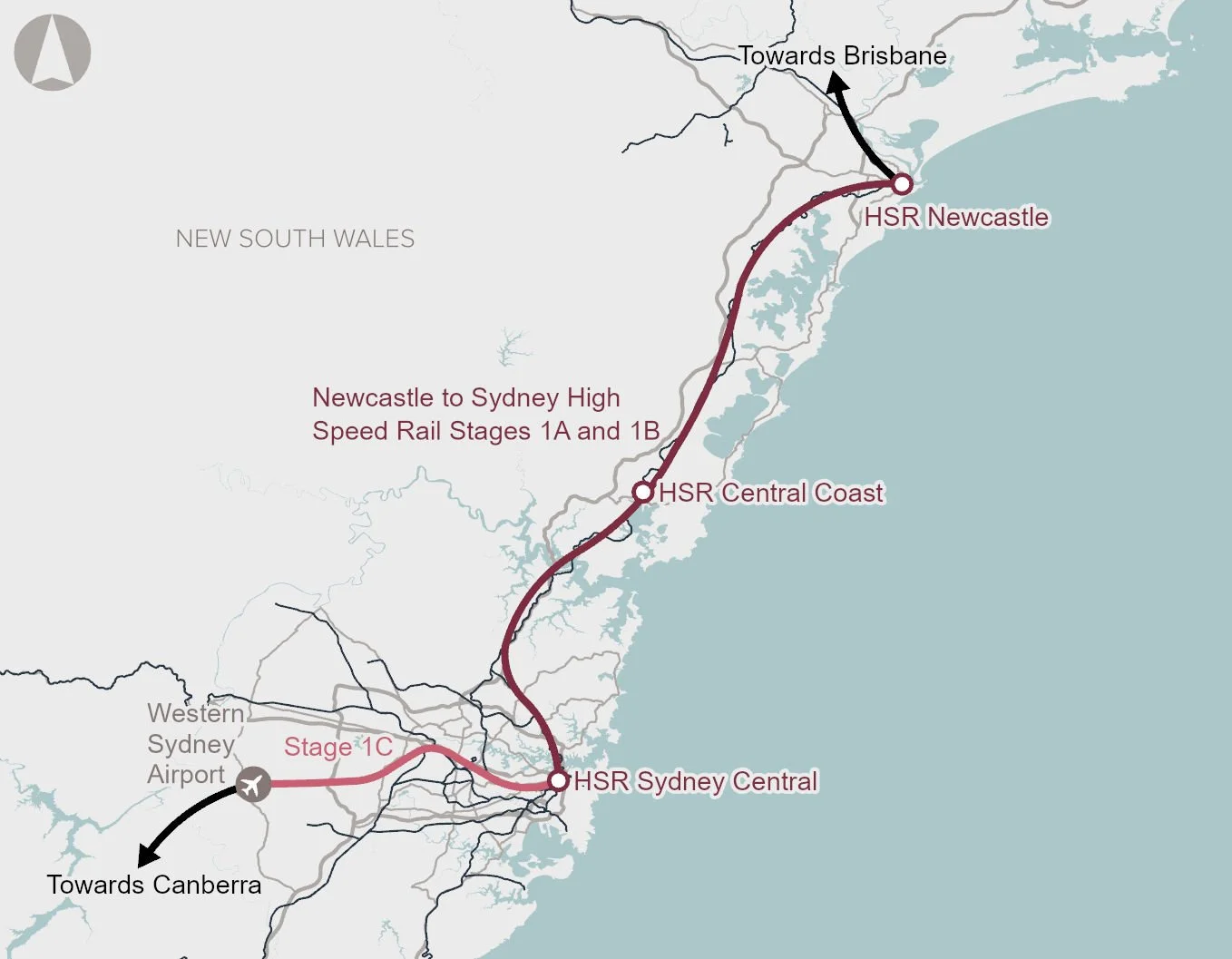
Map showing the proposed first stage of Australia’s east coast high-speed rail network, connecting Newcastle, the Central Coast and Sydney, with future connections toward Brisbane and Canberra.
The Vision: Brisbane to Melbourne by Rail
The long-term vision is essentially a high-speed transportation spine running along Australia's eastern seaboard.
The network would ultimately link Brisbane, Sydney, Canberra and Melbourne, along with strategically important regional centres. Infrastructure Australia describes the future stages as connections between Australia's east coast capitals and regional communities, with the network being progressively expanded from the initial Sydney–Newcastle project. citeturn0search7
The project would use dedicated high-speed railway infrastructure rather than simply placing faster trains onto existing tracks.
That distinction matters.
Much of Australia's existing passenger rail network shares infrastructure with suburban trains and freight services. Curves, signalling systems, crossings and other limitations also restrict speeds. Genuine high-speed rail requires infrastructure specifically engineered for sustained high-speed operation.
Under current plans, trains on the first line would be capable of travelling at up to 320 km/h. citeturn0search1
At those speeds, the relationship between Australian cities begins to change dramatically.
Instead of thinking about Newcastle and Sydney as cities separated by a lengthy intercity journey, for example, they could effectively become part of a much larger interconnected economic region.
That is central to the government's argument for the project.
Stage One: Newcastle to Sydney
Australia isn't starting with Sydney to Melbourne or Sydney to Brisbane.
Instead, the first major project is a dedicated high-speed railway between Newcastle and Sydney.
The proposed first line is approximately 194 kilometres long and includes stations at Newcastle, Lake Macquarie, the Central Coast, Sydney Central, Parramatta and Western Sydney International Airport. Infrastructure Australia's evaluation describes an exceptionally complex engineering project, including approximately 115 kilometers of tunnels, 41 kilometers of surface track and 38 kilometers of bridges and viaducts. citeturn0search34
The planned trains would travel at speeds of up to 320 km/h outside tunneled sections, while speeds through tunnels could reach around 200 km/h. citeturn0search34
The headline benefit is travel time.
The High Speed Rail Authority says the journey between Newcastle and Sydney would take around one hour, while passengers travelling from the Central Coast could reach either Newcastle or Sydney in approximately 30 minutes. citeturn0search0
That represents a fundamental improvement over existing intercity rail.
It could make commuting between the Central Coast, Newcastle and Sydney far more practical and dramatically expand the geographical area from which businesses could recruit employees.
The project has also moved beyond being simply another study. In 2026, the government moved Newcastle–Sydney into a development phase, with procurement processes beginning for major components including tunnels, trains and stations. However, major construction contracts still depend on a future government investment decision. citeturn0search1
That distinction is important: Australia is significantly further along than in many previous high-speed rail proposals, but the railway is not yet guaranteed to be built.
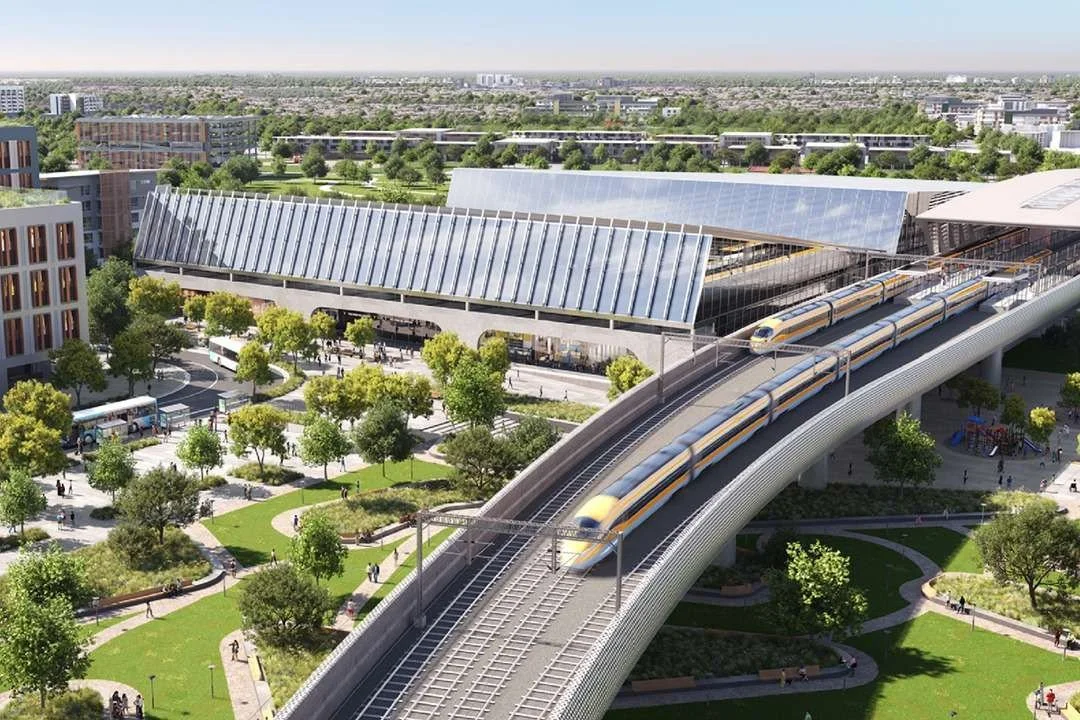
Artist’s impression of a modern high-speed train representing Australia’s proposed east coast rail network. Trains on the Newcastle–Sydney line are planned to be capable of speeds up to 320 km/h.
Why Start With Newcastle?
At first glance, Newcastle might seem an unusual starting point. Sydney–Melbourne is one of Australia's most important travel corridors, while Sydney–Brisbane is another obvious candidate for high-speed rail.
But Newcastle provides something of a proving ground.
The Newcastle–Sydney corridor contains several rapidly growing communities, particularly around the Central Coast. Improving transport connections could therefore serve both intercity passengers and commuters.
Infrastructure Australia says the project is intended to address connectivity challenges, rapid population growth and housing pressures along the corridor. citeturn0search8
That last issue may prove particularly important.
Sydney's housing affordability challenges have placed enormous pressure on households. Faster transport could potentially allow more people to live outside metropolitan Sydney while retaining access to jobs within the city.
A worker living on the Central Coast, for example, could theoretically have a rail journey to Sydney comparable to — or even shorter than — some existing suburban commutes.
High-speed rail therefore becomes more than a transportation project. It becomes part of a broader housing and regional-development strategy.
Building the Rest of the East Coast Network
Newcastle–Sydney is intended to become the first piece of something much larger.
Infrastructure Australia's evaluation documents outline a staged approach. Beyond the initial Newcastle–Sydney project, later stages could connect Melbourne with regional Victoria, Canberra with Sydney, and Brisbane with South East Queensland and northern New South Wales. Further connections would ultimately link regional Victoria to Canberra and Newcastle northwards toward Queensland, completing the east coast system. citeturn0search34
That would create a continuous high-speed corridor linking Australia's largest eastern cities.
The potential impact would be enormous.
A completed network would provide an entirely new option for intercity travel. Instead of automatically choosing between a plane and a car, millions of Australians would have a third realistic option.
Infrastructure Australia notes that high-speed rail could provide a competitive alternative to aviation on some of Australia's busiest flight corridors. citeturn0search9
And that could fundamentally alter Australia's domestic transportation market.
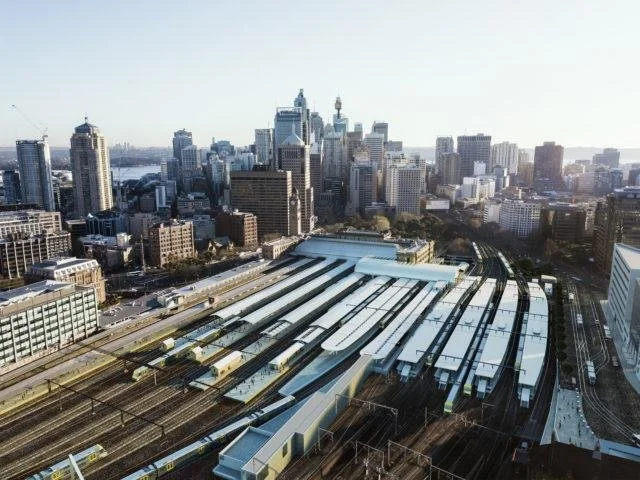
Sydney Central Station and the surrounding Sydney CBD. Central Sydney is proposed as a major station on the Newcastle–Sydney high-speed rail line.
High-Speed Rail Versus Flying
Australia's geography has always been one of the strongest arguments against high-speed rail.
The country is enormous, while its population is relatively small and concentrated in widely separated metropolitan areas.
But Australia's population distribution also creates an argument for high-speed rail.
Brisbane, Sydney and Melbourne form a heavily populated eastern corridor, and air travel between these cities is extremely important.
High-speed trains do not necessarily need to beat aircraft in raw travel time to compete effectively.
Airline passengers must travel to an airport, arrive before departure, pass through security, wait for boarding, fly, collect baggage and then travel from the destination airport into the city.
Railway stations can often be located much closer to central business districts.
That means a train taking several hours between city centres can potentially compete with a much shorter flight when total door-to-door travel time is considered.
Rail also offers passengers something aircraft struggle to provide: productive travel time.
Passengers can generally move around more freely, use laptops throughout the journey and avoid many of the interruptions associated with boarding and airport security.
For business travellers in particular, that could make high-speed rail attractive even when flying remains somewhat faster.
Regional Australia Could Be the Biggest Winner
The most transformative effects might not occur in Sydney or Melbourne at all.
They could occur in regional cities.
A high-speed railway effectively changes economic geography by shrinking travel times between communities.
A regional city that once felt several hours away from a capital could suddenly become accessible within an hour or two.
That expands employment markets in both directions.
Regional residents gain access to metropolitan jobs, universities and services, while metropolitan businesses gain access to a larger workforce.
It could also encourage companies to establish offices outside expensive capital-city centres.
The High Speed Rail Authority argues that the network could allow Australians greater flexibility in choosing where they live while maintaining access to employment and other opportunities. citeturn0search6
If that happens, high-speed rail could support the development of regional economic cenutries rather than simply funneling more people into Sydney, Melbourne and Brisbane.
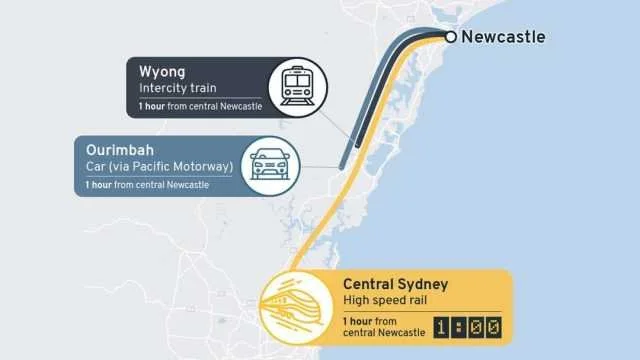
Concept image illustrating the proposed Sydney–Newcastle high-speed railway, the first stage of Australia's planned east coast network. The project aims to reduce Newcastle–Sydney journeys to around one hour.
The Environmental Argument
Transportation will also have to play a role in Australia's transition toward net-zero emissions.
High-speed rail potentially offers a lower-emissions alternative to both driving and domestic aviation, particularly when trains operate using increasingly renewable electricity.
Infrastructure Australia identifies sustainability and lower transport emissions among the potential benefits of improved intercity rail. citeturn0search9
There is an important caveat, however.
Building high-speed rail itself produces substantial emissions.
Tunnelling, manufacturing steel, producing concrete, constructing bridges and moving millions of tonnes of material all carry significant carbon costs.
The environmental case therefore depends heavily on long-term passenger numbers, construction methods, electricity sources and how many journeys shift from cars and aircraft onto trains.
A heavily used railway operating for many decades could produce substantial environmental benefits. An enormously expensive line attracting relatively few passengers would be much harder to justify.
Then There Is the Cost
This is where Australia's high-speed rail dream becomes considerably more complicated.
Building dedicated rail infrastructure through densely developed areas and difficult terrain is extraordinarily expensive.
The Newcastle–Sydney project illustrates the challenge particularly well. More than half of its approximately 194-kilometre alignment would involve tunnelling. citeturn0search34
In February 2026, reporting based on the released business case put the estimated cost of the first two Newcastle-to-Sydney stages at approximately A$61.2 billion, including trains. citeturn0search12
That is before completing anything resembling the full Brisbane-to-Melbourne network.
Governments therefore face a difficult question: are the economic, social and environmental benefits large enough to justify such extraordinary upfront expenditure?
Supporters argue that major infrastructure should be evaluated over generations rather than election cycles.
The government says the Newcastle–Sydney business case estimates the project could generate around $250 billion in economic activity, while the High Speed Rail Authority says construction could support up to 15,000 jobs per year at its peak. citeturn0search2turn0search1
Critics, however, will understandably scrutinise assumptions about passenger numbers, construction costs, land values and wider economic benefits.
Megaprojects also carry significant cost-overrun and schedule risks.
Australia would need to manage those risks carefully if public confidence in the project is to survive decades of planning and construction.
Why Australia Hasn't Built It Already
High-speed rail is hardly a new Australian idea.
Proposals have appeared repeatedly over several decades. Governments have commissioned studies, examined potential corridors and debated the economics, only for projects to stall.
Part of the problem has been scale.
Unlike building a motorway bypass or extending an urban railway, an east coast high-speed network requires coordination across multiple states and territories, enormous capital expenditure and planning horizons extending well beyond individual governments.
That makes political continuity essential.
The creation of the High Speed Rail Authority, which formally began operating in 2023, is an attempt to provide a dedicated national institution capable of planning and overseeing the network over the long term. citeturn0search33
Whether that is enough to carry the project through future governments remains one of its biggest unanswered questions.
What Would High-Speed Rail Change?
Imagine an Australia several decades from now in which the entire network has been completed.
A passenger could board a high-speed train in Brisbane and travel south through regional centres toward Newcastle and Sydney. From Sydney, services could continue toward Canberra and ultimately Melbourne.
Regional communities that once seemed distant from the capitals could become realistic commuting or business locations.
Domestic airlines might increasingly focus on longer-distance routes where aviation retains a decisive advantage.
Sydney Airport could face less pressure from short-haul domestic flights.
Businesses might gain access to larger labour markets.
Tourism between connected cities and regional communities could become easier.
And Australians could begin thinking about distance differently.
That may ultimately be the most significant effect of high-speed rail.
Railways do not physically move cities closer together, but economically and socially, they can have almost the same effect.
Will It Actually Happen?
Australia still does not have a completed high-speed railway, and there remains a substantial distance between today's development work and passengers boarding trains travelling at 320 km/h.
The Newcastle–Sydney project must still progress through detailed design, environmental approvals, procurement and ultimately a final government investment decision before major construction contracts are awarded. citeturn0search1
The remainder of the east coast network is even further away.
Infrastructure Australia currently characterises the future east coast stages as a potential investment opportunity in the two-to-four-year planning pipeline, rather than as construction-ready projects. citeturn0search7
Nevertheless, the current proposal represents one of Australia's most serious attempts yet to move high-speed rail from reports and concept maps toward physical infrastructure.
The question is no longer simply whether high-speed rail would be technically possible in Australia. Countries around the world have demonstrated the technology for decades.
The real questions are whether Australia is prepared to pay for it, whether governments can maintain support across multiple election cycles and whether the economic benefits justify the enormous investment required.
If those challenges can be overcome, Australia's east coast high-speed rail network could become one of the country's defining infrastructure projects of the 21st century.
For generations, Australians have talked about high-speed rail.
This time, they may actually get to ride it.
